Paulownia in agroforestry: planting, lines, access, mechanization
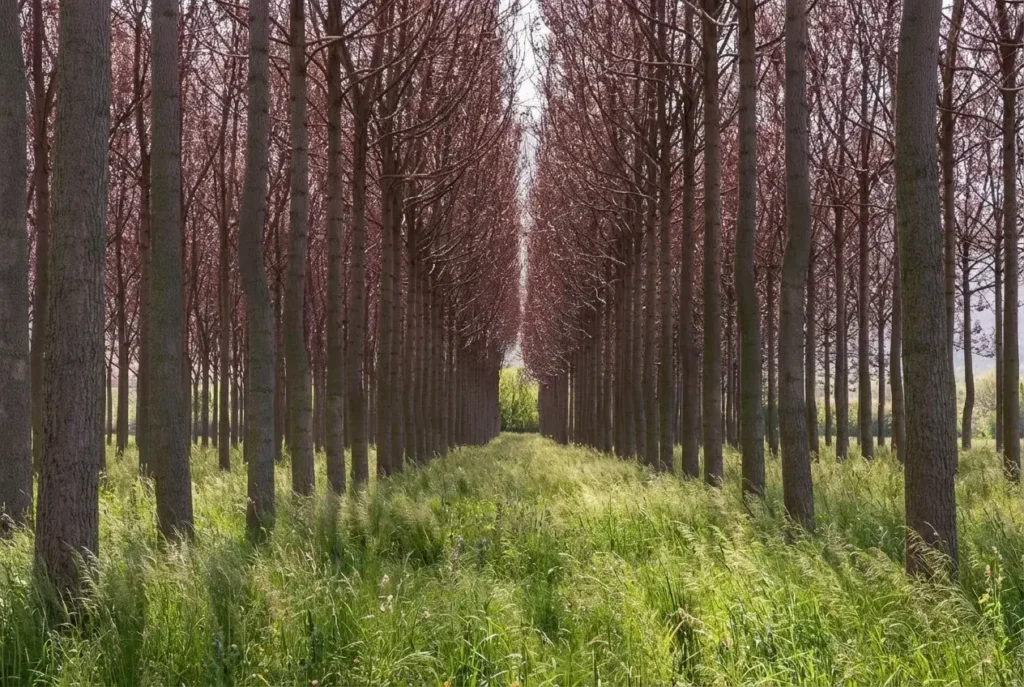
Paulownia in agroforestry: layout, rows, access, mechanisation
Short answer: a “successful” line of paulownia is not designed starting with a species, but with the width of your machinery. You set the row spacing (distance between rows of trees) as a multiple of your widest field operation, then size the in-row spacing according to the objective (timber, biomass or a mix).
A simple regulatory point: for a parcel with scattered forest-species trees (isolated or in lines), CAP eligibility of the area depends on a density below 100 trees per hectare (excluding hedges; fruit trees are not treated in the same way). Before planting, have your layout validated by your DDTM or your CAP adviser.
Why paulownia in agroforestry
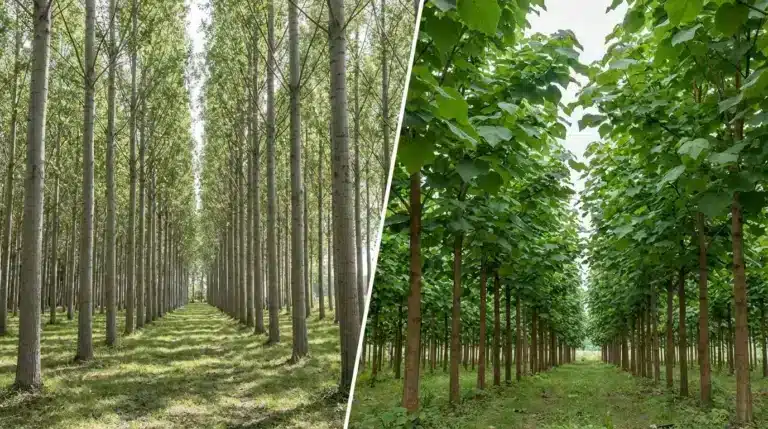
Paulownia is sought after for its rapid growth and its potential outlets for light wood. In agroforestry, the point is not “to plant trees”, but to create a system in which the trees coexist with the crops without breaking the mechanics of the farm.
If you are just starting, begin by reading: paulownia growth in France and invasiveness risk: responsible management.
Layout: rows, orientation, access, headlands
Practical rule no. 1: row spacing = a multiple of your machinery
The row spacing (distance between rows of trees) must “fall exactly” on your working widths: sprayer, drill, boom, combine harvester. This limits manoeuvring and protects the trunks.
Practical rule no. 2: a dedicated strip around the line
Providing a stabilised strip (often grassed) around the line of trees makes passes safer, reduces injuries and simplifies maintenance.
Orientation of the rows
- North–South : often chosen to even out sunlight on the crop side.
- Perpendicular to the prevailing winds : if the aim is a “windbreak” (to be assessed according to the site).
Access and headlands
- Size your headlands for your largest turns (combine harvester, trailers, spreader).
- Provide at least one durable access for planting, pruning and harvesting the wood.
- If you use RTK guidance, align the tree lines with the tramlines : it is a major gain over 10–15 years.
Density per hectare according to your row spacing
Density is simply calculated as: trees per hectare = 10,000 / (row spacing in m × in-row spacing in m).
| Spacing between rows of trees (m) | In-row spacing (m) | Density (trees per hectare) | At a glance |
|---|---|---|---|
| 22 | 4 | 114 | Very structuring. Strong agroforestry impact, but more CAP constraints if you exceed the thresholds. |
| 22 | 5 | 91 | Often consistent with the CAP ceiling of “100 trees/ha” for forest trees. |
| 22 | 6 | 76 | “Safer” on density, simpler management. |
| 36 | 4 | 69 | Row spacing compatible with many arable-crop operations. |
| 36 | 5 | 56 | Good compromise between mechanisation and number of trees. |
| 36 | 6 | 46 | Even smoother management, lighter “tree” effect. |
| 57 | 4 | 44 | Very little penalty on work rate, but fewer trees overall. |
| 57 | 5 | 35 | “Large field” design, mechanisation first. |
| 57 | 6 | 29 | Minimalist: easy to live with, more diffuse effects. |
Density benchmarks along the line in agroforestry (paulownia in tree lines) and the CAP eligibility threshold (forest trees): see sources at the end of the article.
Staying agricultural: CAP points to watch (DDTM, inspections)
A simple threshold to remember
On Télépac, if the parcel contains scattered forest-species trees (isolated or in lines), their number must be below 100 trees per hectare for the parcel to be eligible. Prefectural information sheets and the eligibility guide repeat this point. Fruit trees do not follow the same logic.
Practical advice
Before planting, send your DDTM or CAP adviser: the layout plan (row spacings, in-row spacings), the type of trees, photos of the parcel, and areas. This avoids 90% of unpleasant surprises at inspection.
And “agroforestry” support (pillar 2)
For some establishment support measures (depending on region and call), a “target” density may be required (examples observed: a density between 30 and 250 trees per hectare, depending on the scheme). This depends on the programme and does not replace the rules on area eligibility.
Tree management: what makes for quality and survival
Establishment and take
- Choose a well-drained plot, and avoid waterlogged areas.
- Manage the grass around the plant: this is often the no. 1 factor of success.
- If the objective is “quality”, securingwater in the first years changes everything.
Training and pruning
- A log is made: select one dominant stem and remove early forks.
- Progressive pruning: avoid cutting too hard in one go (risk of stress and defects).
To go further: when to plant paulownia · where to plant: distances, networks, neighbouring land.
Documented environmental benefits
Agroforestry: widely documented effects
French technical references summarise effects on soils (erosion, structure), functional biodiversity and carbon storage, with results that depend heavily on design and site.
Paulownia: subjects studied
Paulownia is also studied in the literature for biomass production and certain phytoremediation contexts, but results depend heavily on conditions (soil, water, contaminants).
For a practical, field-based approach, first think through water, wind and bearing capacity: without these, the benefits remain theoretical.
Checklist before planting
Machinery
Width of sprayer, drill, combine harvester. Set the row spacing as a multiple.
Access
Parcel entrances, headlands, passing areas, winter bearing capacity.
Water
Mains supply, tanks, drip irrigation possible. A priority if quality is the objective.
Regulatory
Check CAP eligibility (trees/ha threshold) and local rules. DDTM validation advised.
Paulownia plants and guides
Start from a clear objective: timber, biomass, or an agroforestry mix.
Useful internal links: paulownia hub · growth in France · short rotation coppice (SRC) · firewood
FAQ
What density should I aim for so as not to hinder mechanisation?
In arable farming, many designs aim for wide row spacings (e.g. 36 m or more) and widely spaced trees (4 to 6 m along the line). The right choice is the one that does not disrupt your field operations and remains compatible with your CAP constraints.
Is the “100 trees per hectare” threshold a rule everywhere?
It is an important benchmark in the CAP eligibility rules for scattered forest-species trees (isolated or in lines). Special cases exist (type of trees, grassland, pro rata), hence the value of validating your layout with the DDTM.
What in-row spacing for paulownia in agroforestry?
Technical benchmarks often cite 4 to 6 m between trees along the line in tree lines. Adjust according to objective (quality, biomass), vigour and management constraints.
What are the main risks to success?
Water stress, drying wind, waterlogged soil, grass competition at the base, and mechanical injuries. The design (dedicated strip, access) greatly reduces these risks.
External sources: Télépac eligibility guide (100 trees/ha threshold for forest-species trees); summary of CAP and densities (agroforesterie.fr); benchmarks for in-row density in tree lines (CNPF); agroforestry design material (INRAE).