Paulownia pruning and trimming
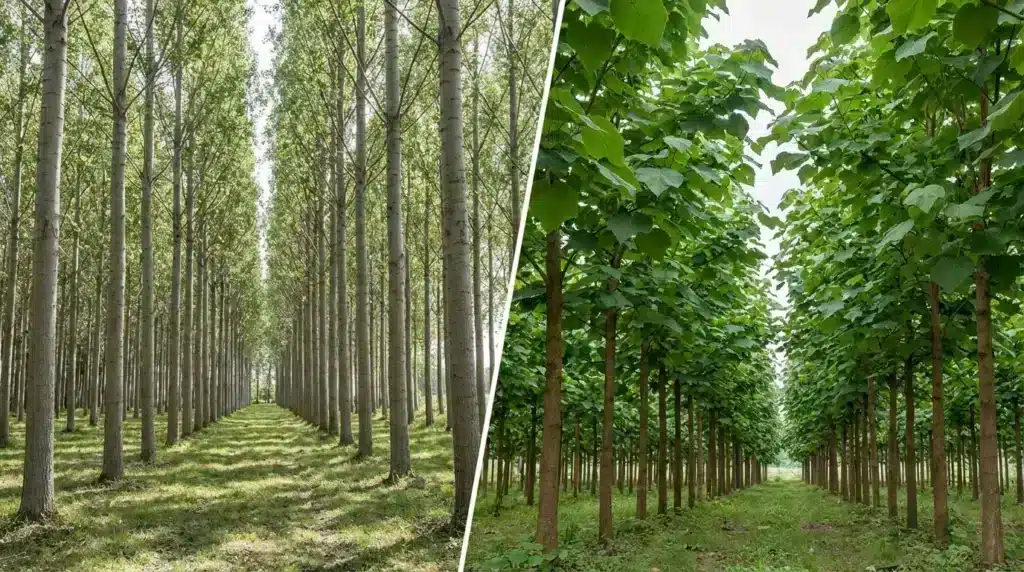
Pruning and Limbing: Paulownia vs Poplar
Producing class A timber (knot-free) calls for a rigorous technique. While poplar forgives late cuts, paulownia demands preventive management. Here is a comparison of the cultivation routes so that you do not spoil your butt log.
The 3 fundamental differences
Poplar: Heals well, even on 5 cm branches.
Paulownia: Heals poorly. The centre is a soft pith that rots if exposed to water.
Poplar: Curative (secateurs/saw). The existing branch is cut off.
Paulownia: Preventive (finger/glove). The bud is removed before it becomes a branch.
Poplar: Once a year (winter).
Paulownia: Every 15 days (May-July) for the first two years.
Special Paulownia technique: “Coppicing”
This is the step that frightens novices most, but it is the key to a perfect trunk.
The principle
If, after the first year, your Paulownia is not perfectly straight, or if it is less than 3-4 metres tall, it must be cut back to ground level (coppicing).
Why cut it back?
The root system is already established. The following spring (Year 2), it will push up a single, ultra-vigorous stem, able to reach 5 or 6 metres in a single season, with no knots at all. This is how a perfect butt log for peeling is obtained.
Comparative intervention calendar
| Season | Paulownia (timber objective) | Poplar (conventional) |
|---|---|---|
| Winter (Feb-March) | Coppicing of imperfect trunks (Year 2). Formative pruning is prohibited on large wood. | Formative pruning. Limbing of low branches with secateurs or a saw. |
| Spring (April-May) | Selection of the sprout (if coppiced). Only the best one is kept. | No major intervention. |
| Summer (May-July) | “Green Pruning” : a pass every 15 days to rub off the green axillary buds. | Health monitoring. |
| Autumn (Sept-Oct) | Complete stop. Let the leaves fall. Do not prune any more, so that the wood can harden off before the frost. | Preparation of winter work sites. |
Technical summary for growers
Show the data in CSV format
species,pruning_type,frequency,main_tool,main_risk
paulownia,preventive_disbudding,monthly_summer,glove_or_finger,heart_rot_if_late_cut
poplar,curative_limbing,annual_winter,secateurs_saw,epicormic_shoots
paulownia_coppicing,cut_to_ground_year2,once,chainsaw,growth_delay_if_weak_root
Pruning FAQ
I missed the disbudding of my Paulownia and I have a 5 cm branch. Should I cut it?
It is risky. If you cut flush, the central hole will show. Cut a little further from the trunk (leave a 5 cm stub) to let it dry, then cut again the following year when the wood is dead, applying a wound sealant.
Up to what height should I prune?
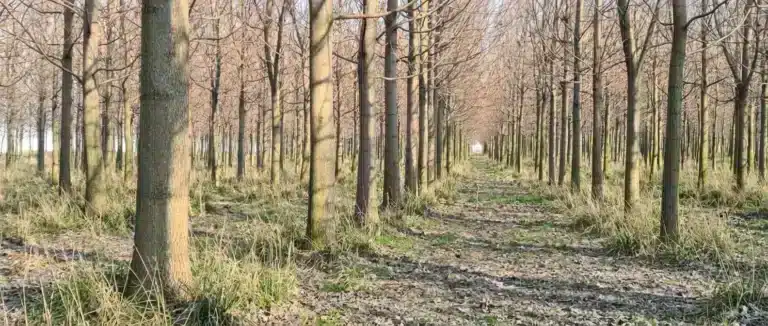
For quality timber, the aim is a “butt log” (the clean trunk) of at least 6 metres . This is the most valuable part. Above it, the crown is left to develop for photosynthesis.
Undecided between Paulownia and Poplar?
Poplar is a safe, hardy choice that requires little labour. Paulownia is a “Formula 1” that demands precise handling but offers a faster return on investment.