
Agribiomix nursery · northern France
Cup plant (Silphium perfoliatum): growing, sowing and yield
The cup plant (Silphium perfoliatum) is a perennial native to North America, grown in Germany as an alternative to silage maize for anaerobic digestion (biogas). It is harvested from the second year and stays in place for 15 years or more. Here is the complete guide, with sourced figures.
- 15+ yearson the same field, 10 to 20 years depending on the source
- Year 2first harvest: in the year of sowing, the cup plant only forms a rosette
- 50 to 80 %of the methane per hectare of silage maize, according to trials
- €1,600 to €2,000per hectare: the most commonly quoted establishment cost by sowing
A giant perennial with fused leaves
The cup plant (Silphium perfoliatum) is a perennial Asteraceae native to North America. Having arrived in Europe as a garden plant, it was used as fodder in the former USSR from the 1950s and was tested by INRA in France from 1974.
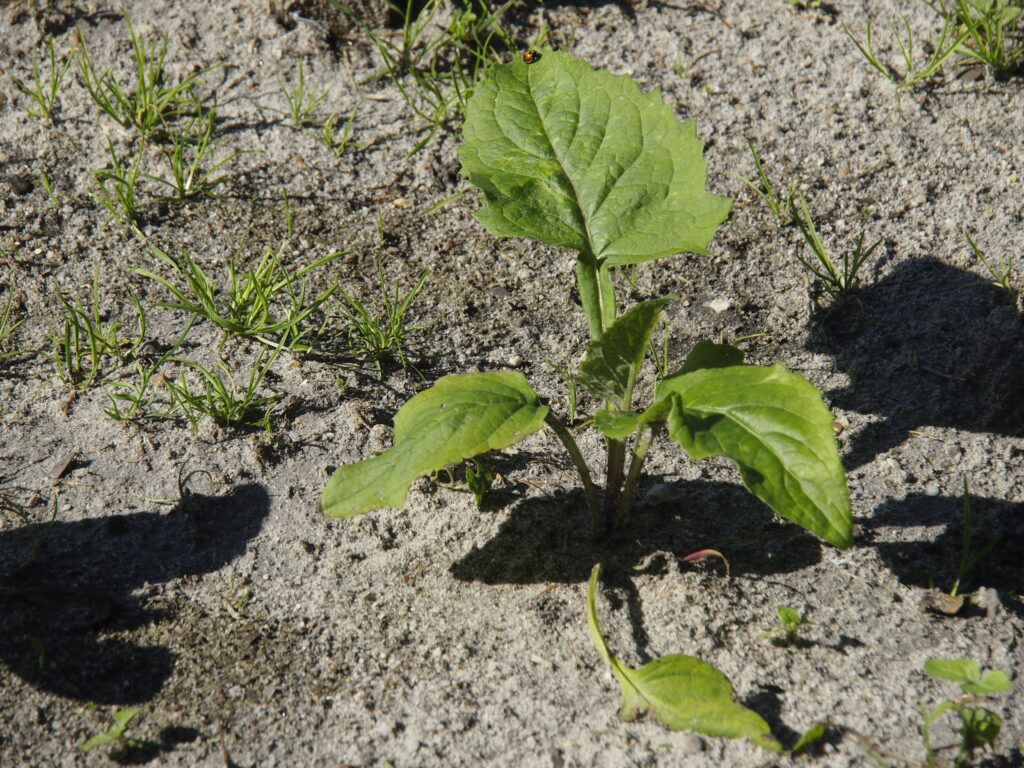
- Cycle: in the year of sowing, a simple rosette; from the 2nd year, square stems up to 3 m tall, with yellow flowers from mid-July to late September.
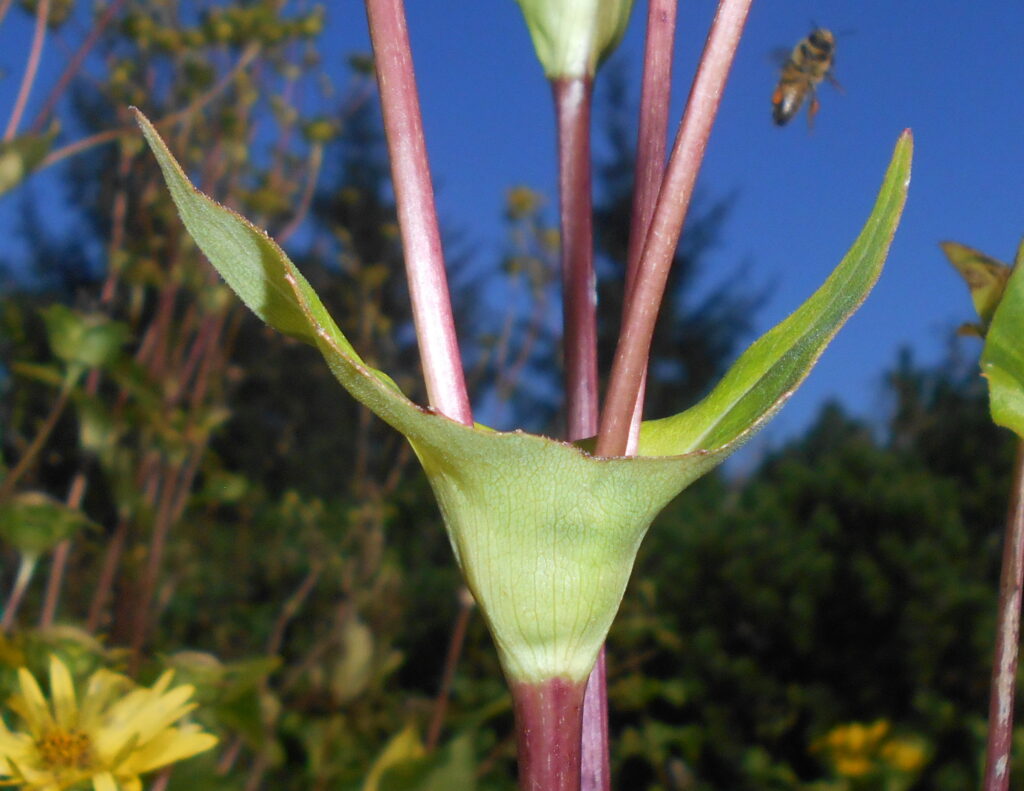
- Leaves: opposite and fused at the base, they form a cup that holds rainwater, hence the name ‘cup plant’.
- Roots: reaching beyond 1.5 m, down to 2.7 m on deep loess, with short rhizomes; it withstands −30 °C.
- Lifespan: 15 years or more in general, 10 to 20 years depending on the source; no published yield monitoring exceeds 7 years.
Uses: anaerobic digestion, fodder, honey and biodiversity
50 to 80 % of maize
Anaerobic digestion
One harvest a year, from late August to mid-September, ensiled for the digester. Potential of 254 to 290 litres of methane per kg of organic matter in Bavaria, against 363 to 369 for maize; per hectare, 50 to 80 % of the methane of a maize crop. In France, it counts as a main crop within the 15 % cap on digester feedstock.
Emergency fodder
Fodder
Value judged close to that of straw in Germany; in Wallonia, two cuts give 10 to 12 % crude protein. Useful mainly in a dry year, without exceeding 30 to 50 % of the ration according to the sources.
August pollen
Melliferous
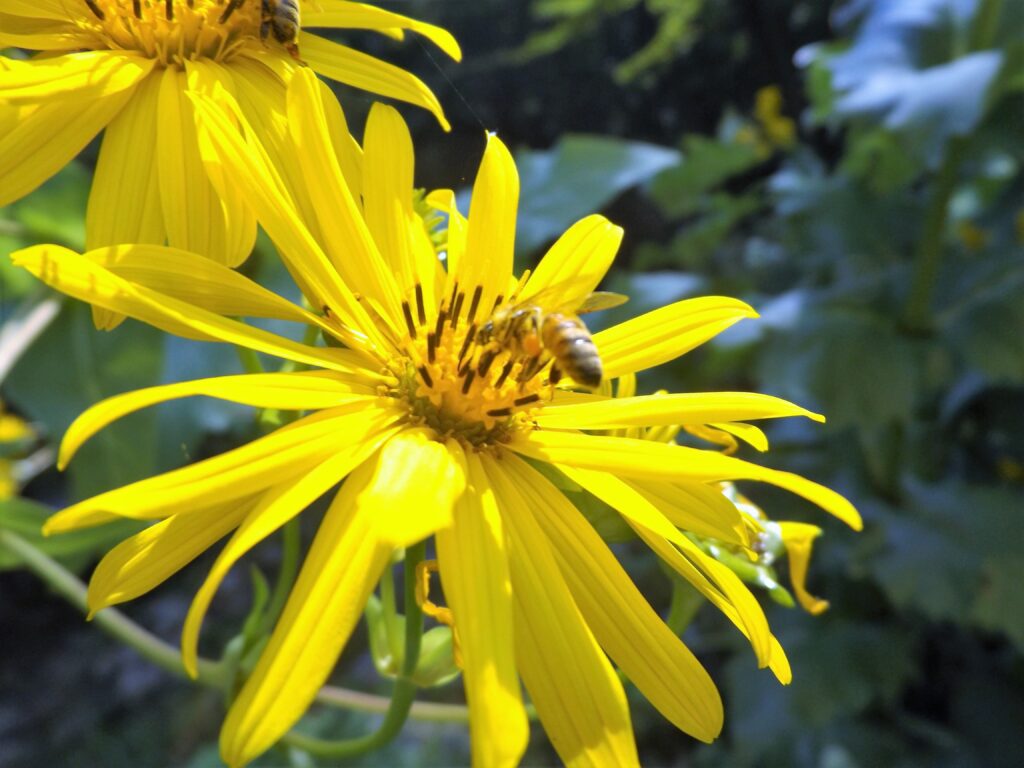
Its long flowering period feeds bees at the end of summer. The honey harvest remains modest: 2 to 6 kg per hive in Wallonia, or about 5 kg per hectare in the Belgian trial.
Seed or plants?
For a long time, only planting guaranteed an even stand. With pre-treated seed, sowing has become the usual practice; after about 5 years, the Bavarian trials no longer show any advantage for planting. Potted plants remain the right solution for small areas, for trials and for filling gaps.
| Seed (sowing) | Plants (planting) | |
|---|---|---|
| Density | 15 to 25 germinable seeds per m², for at least 4 plants/m² | about 4 plants/m², i.e. 40,000 per hectare |
| Cost | €1,600 to €2,000/ha most often (up to €2,600 according to one source) | €3,000 to €5,200 of plants per hectare in Germany, plus planting |
| Timing | mid-April to mid-June, May ideal | mid-May to early June, up to late June according to the sources |
| Success | depends on rainfall and the seedbed (24 % of areas to be resown after the 2018 drought in Franconia) | even stand, best yields in the first years |
| Harvest in year 1 | possible when undersowing in maize (50 to 80 % of a maize crop) | no |
Soil and establishment
- pH: at least 6.5 according to the Belgian trials; avoid acid soils and lime if needed (the cup plant lowers the pH).
- Water: deep soil, good water reserve or access to the water table, more than 600 mm of rain a year. Not recommended on light, shallow soils in dry areas.
- Previous crop: avoid sunflower, oilseed rape and bean (sclerotinia); start from a clean field (dock, thistles and couch grass treated beforehand).
- Seedbed: fine and firm, worked at the surface on soil that has drained, rolled before and after sowing; stale seedbeds exhaust the weeds.
Crop management: year 1, then following years
Sole-crop sowing
From mid-April to mid-June, in soil at 14–15 °C. 15 to 25 germinable seeds per m², at a depth of 1 cm (2 cm at most in dry conditions), rows 37.5 to 50 cm apart. The rate in kg/ha is calculated from the thousand-seed weight of the seed lot: seeds/m² × thousand-seed weight (g) ÷ 100.
Undersowing in maize
Harvest of 50 to 80 % of a maize crop from year 1, with a less dense maize (5 to 6 plants/m²) sown first. Best kept for good soils and wet years: in Wallonia, worthwhile one year in three.
Planting
About 4 plants per m² with a vegetable transplanter, from mid-May to early June; water if the weather stays dry. Target in autumn: a rosette of 10 to 12 leaves and at least 4 plants/m².
First harvest in year 2, full yield in the 3rd or 4th year depending on the source. After cutting, the cup plant regrows before winter and takes up soil nitrogen.
| Month | Year 1 (sowing) | Year 2 (first harvest) |
|---|---|---|
| January–February | soil analysis, liming decision | analyses, base fertilisation plan (potash, magnesia, calcium) |
| March | liming if needed, stale seedbed | growth restarts, nitrogen application; digestate from late March to mid-April |
| April | fine, rolled seedbed; sowing from mid-April on warmed soil | last nitrogen before stem elongation; rotary cultivator between the rows as long as the cup plant is under 70 to 100 cm |
| May | most favourable month for sowing; emergence after about 14 days | watch weeds and grasses |
| June | sowing possible until mid-June; first hoeing with crop guards | clean-up mulching if weeds dominate |
| July | late hoeing; rescue mulching if needed | start of flowering |
| August | stand check | flowering; harvest possible from mid-August |
| September | harvest of the cover maize when undersowing in maize | main harvest, one cut, at 23–28 % dry matter |
| October | check: at least 4 plants/m² | end of harvest in Wallonia; regrowth |
| November–December | nothing | plan the base fertilisation according to crop offtake |
Weed control and fertilisation
- Establishment year: the cup plant starts slowly, so this is the critical year. Hoeing from the first weeks with crop guards (the young plant does not tolerate earthing-up), then a late pass; a rotary cultivator between the rows reduced thistles by more than 90 % in a Bavarian trial. If weeds dominate, rescue mulching leaves no lasting damage.
- Products: in France, no herbicide is authorised on the cup plant; consult your adviser and e-phy before any intervention.
- Afterwards: from the 2nd year, a dense stand smothers weeds; grasses and dock may spread with age.
- Nitrogen: 100 to 160 kg N/ha a year for 12 to 18 t of dry matter according to most sources (about 9 units per t of dry matter; 12 to 15 for maize); digestate is put to good use, applied early in spring.
- Base fertilisation: for about 15 t of dry matter, 60 to 70 kg of P2O5, 240 to 300 of K2O, 85 to 115 of MgO and 280 to 420 of CaO are removed: 5 to 10 times more calcium is removed than with maize, hence regular analyses and liming.
Harvest and yield
Harvest takes place from mid-August to mid-September in Germany, at 23–28 % dry matter; Wallonia aims for at least 28 % and harvests until early October. A direct-cut forage harvester, cutting at 5–10 cm above the ground, is suitable; a late harvest lowers the methane yield.
Yield varies greatly between trial plots and farm fields: we therefore give both.

| Context | Dry matter per hectare |
|---|---|
| Trial plots (Bavaria, planting, good soils) | 12.5 to 21.5 t |
| Monitored farms in Upper Franconia (2018 to 2022) | 6.6 to 10.1 t depending on the year |
| Wallonia, 3rd year | 10 to 16 t, less than 10 t in 2024 |
| France, first monitored harvests | 4 to 12 t |
| Average of the literature (2020 review) | 13.3 t (from 2 to more than 32 depending on the site) |
Cup plant or silage maize: the comparison
| Criterion | Cup plant | Silage maize |
|---|---|---|
| Cycle | perennial, 15 years or more | annual |
| First harvest | year 2 (or 50 to 80 % of a maize crop from year 1 when undersowing in maize) | the year of sowing |
| Methane per kg of organic matter | 254 to 290 litres | 363 to 369 litres |
| Methane per hectare | 50 to 80 % of maize | reference |
| Nitrogen | 9 units per t of dry matter | 12 to 15 units |
| Working time | 3.5 to 3.9 h/ha a year (15-year average, Bavaria) | 6.1 to 6.7 h/ha a year |
| Plant protection products | none after establishment, except for grasses if needed | annual programme |
| Drought | −33 % yield in dry conditions | −18 % |
| Erosion | less than a quarter of that of maize, from 10 years | reference |
| Annual cost (Wallonia) | about €750/ha | about €1,200/ha |
In summary: the cup plant wins on inputs, labour, erosion and nitrates; it loses on methane per hectare and on the first year. It is mainly justified on remote or difficult fields, fields prone to erosion or located over a water catchment.
Costs and profitability
- Establishment by sowing: €1,600 to €2,000/ha most often, €2,600 according to one source; it all depends on what is counted (seed, starter fertiliser, weed control, sowing).
- Establishment by planting: €3,000 to €5,200 of plants per hectare in Germany, plus planting; in Thuringia in 2018, €4,642/ha in total.
- Amortisation: €1,800 over 15 years comes to €120 per hectare per year, €90 over 20 years.
- Versus maize: a m³ of methane costs €0.49 for cup plant sown and managed for 10 years, against €0.46 for maize according to the Bavarian institute LfL; the cup plant becomes competitive from 10 years of cultivation (15 on very good soils).
- Please note: no independent study of the margin in France for 2026 was found; do the calculation with your own price for the crop.
Subsidies and environment
- CAP (France, 2026): to be declared as a ‘perennial high-biomass crop’, code MSW, precision 004, as a permanent crop. Its status for ecological focus areas is to be checked with your DDT (local agriculture office).
- Subsidies: no French subsidy specific to the cup plant was found. Abroad, Bavaria funds the seed and Wallonia pays €300/ha for 3 years on drinking water catchments.
- Water and soil: low autumn residual nitrogen (26 to 47 kg N/ha in Franconia), erosion reduced fourfold to eightfold compared with an annual crop from 10 years. The risk remains high in the establishment year.
- Biodiversity: 1.2 to 1.5 times more species of spiders and ground beetles than in maize; pollinators are mostly common species (bees, bumblebees, hoverflies).
Drawbacks and limitations
- Slow establishment, no harvest in the first year when sown as a sole crop, weed competition and a high establishment cost.
- No more drought-resistant than maize: yields collapsed in 2022 in Franconia.
- Lodging on very rich soils, sclerotinia in a wet year, ensiling that is delicate at low dry matter.
- Less methane per hectare than maize, and no herbicide authorised in France on the crop.
- Invasiveness: judged low to medium by the Bavarian centre TFZ, but a University of Bayreuth study found self-sown plants around 13 fields out of 15, up to 700 m away. Harvest at maturity and avoid watercourse margins.
- End of the crop: without deep rhizomes, the field can be ploughed up without major difficulty; rotary tilling to 7–10 cm leaves the least regrowth.
Our seed and plants
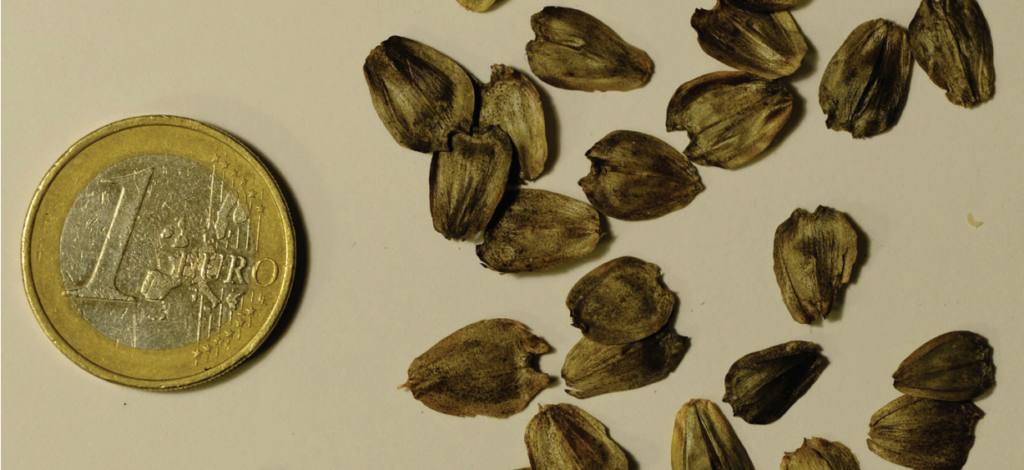
Cup plant seed (3 kg bag)
EU-certified, pre-treated seed, for sole-crop sowing or undersowing in maize. Photo: Lukas Hummel, CC BY 4.0.
See the seed →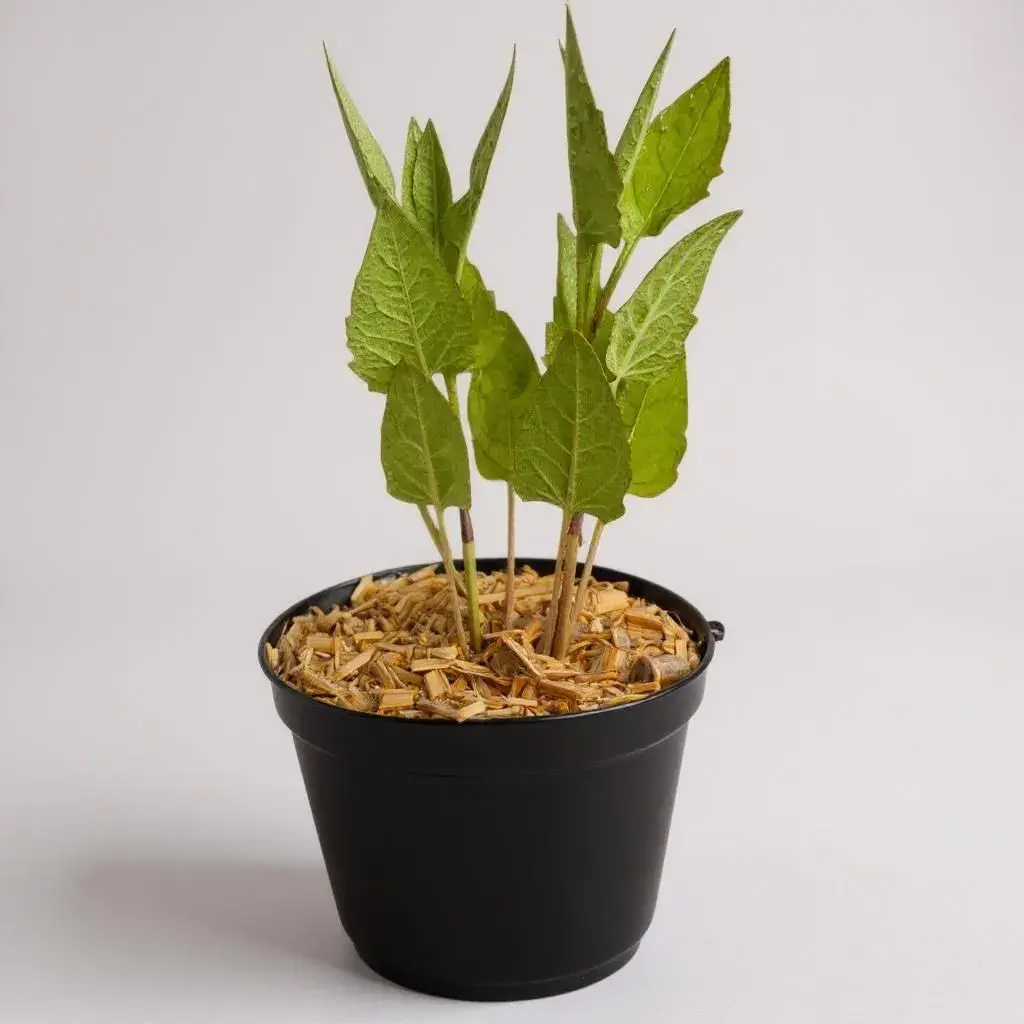
Potted plants
One-year-old plants in 2-litre pots, for a trial, a small area or to fill gaps.
See the plants →
Compare the crops
Cup plant, miscanthus, paulownia, poplar, willow, bamboo: yields and outlets side by side.
Compare →Cup plant growing guide
Frequently asked questions about the cup plant
How long does a cup plant crop last?
From 10 to 20 years depending on the source, 15 years or more in general. No published yield measurement yet exceeds 7 years.
When is the first harvest, and how much?
In year 2, with full yield in the 3rd or 4th year. From 6.6 to 10.1 t of dry matter per hectare on the monitored farms in Franconia, from 12.5 to 21.5 t on the Bavarian trial plots.
Seed or plants?
Sowing has become the usual practice; planting costs more and keeps no advantage after about 5 years. Plants are mainly for small areas, trials and gaps.
What sowing rate?
Aim for 15 to 25 germinable seeds per m². The rate in kg/ha depends on the thousand-seed weight of the seed lot: from 2.3 to 3.8 kg/ha according to the Bavarian centre TFZ.
How do I control weeds in the first year?
Row hoe fitted with crop guards, rescue mulching if needed, rotary cultivator between the rows on weedy fields. No herbicide is authorised on cup plant in France: ask for advice before any intervention.
How much methane compared with silage maize?
From 50 to 80 % of the methane per hectare according to the trials. The cup plant is mainly justified by its low inputs, erosion control and difficult fields.
Are there any subsidies?
No French subsidy specific to the cup plant was found. It is declared as MSW004, permanent crop. Subsidies exist in Bavaria and Wallonia.
Is it invasive?
Risk judged low to medium, but self-sown plants have been observed around German fields: harvest at maturity and avoid watercourse margins.
Sources
The cup plant is still little studied in France: this page relies mainly on German work (the TFZ centre in Straubing, the Upper Franconia administration, the JKI, Thünen and LfL institutes) and Belgian work (Wallonia), as well as on the chambers of agriculture of Nouvelle-Aquitaine, Cantal and Somme and on the 2026 CAP notice. Seed suppliers’ product sheets are commercial sources. Consulted: 02/11/2026. Where sources diverge, we give ranges.
A cup plant project?
Area, soil, outlet: we help you choose between sowing and planting and calculate your needs.