Giant bamboo (Phyllostachys): biomass yield and profitability per hectare

Giant bamboo (Phyllostachys): yield, end markets and biomass profitability per hectare
Running bamboo is a crop with high volume potential: fast growth, regeneration from rhizomes, regular production once established. To think in terms of “biomass”, we think in terms of dry matter, harvest and end-use channel. Profitability depends mainly on 3 variables: yield, selling price and harvest/logistics cost.
Quick access
Bamboo page, list of varieties, running bamboo plants, and control guide.
1) Yield: the right unit is dry matter
In biomass, water distorts the comparison. Bamboo can be harvested “green” and then dried, or used through a channel that accepts a higher moisture content. To compare crops, everything is brought back to dry matter.
2) Harvest: “medium” culms vs giant bamboo
Mechanisation is decided by the dominant diameter. Below a certain threshold, the operation can come close to an agricultural worksite (cutting + chopping). With giant bamboo, we shift to a “cane” approach: cutting culms, then crushing/shredding.

Example of harvesting by culms on giant bamboo.
3) Profitability: under certain conditions
The profitability of a plantation is reasoned like a perennial crop: initial investment (plants + preparation + water), then recurring income (harvests) with a gradual start. The critical point is to align yield, outlet and harvest cost.
Key point: the selling price depends on the outlet (energy, fibres, canes, etc.).
| Assumption | Yield (t DM/ha/year) | Selling price (€/t DM) | Gross revenue (€/ha/year) | Interpretation |
|---|---|---|---|---|
| Cautious | 10 | 90 | 900 | Basic outlet, priority on securing the operation. |
| Standard | 13 | 130 | 1,690 | Order of magnitude consistent with a contracted valorisation and monitored crop management. |
| Ambitious | 18 | 150 | 2,700 | Requires solid crop management and an outlet that rewards dry matter. |
| Very ambitious | 25 | 150 | 3,750 | To be reserved for very favourable contexts + local evidence (weighing, moisture, consistency). |
This table serves to frame the discussion. The final figure depends mainly on the actual harvest cost, the distance, storage and the contract.
4) Possible outlets (often combinable)
Bamboo can supply several markets. Some uses can be combined on the same plantation, provided that the material is sorted/graded and logistics are secured. In France, the sector is still under construction : it is progressing, but the ramp-up is measured in years.
- Energy : shredded material/chips for heat and industry, relevant if a consumer is nearby or if a platform exists.
- Fibres and insulation : an example in the north of France with Fiboo at Blaringhem (59), which is developing bamboo-fibre insulation panels, with a regional supply-chain approach.
- Materials : panels, composites, plant-based reinforcements, often demanding in terms of quality and consistency.
- Canes and stakes : attractive unit value, but requires sorting, grading, drying and standardisation.
- Agricultural uses : mulch, bedding, organic soil amendments according to local specifications (cleanliness, moisture, particle size).
5) Carbon: a real opportunity, framework still under construction
Bamboo stores carbon in biomass and can contribute to low-carbon pathways. “Carbon” valorisation depends on a framework: methodology, monitoring, verification, and the credibility of the certificates.
- Europe : a voluntary certification framework for carbon removals and carbon storage exists, with methodologies that are being built up gradually.
- France : the Label bas-carbone (French low-carbon label) frames projects, but there is currently no widely standardised “bamboo” methodology.
- Voluntary markets : private schemes exist, with variable levels of quality. Rigour of monitoring and verification is central.
Going further

Running bamboos: see the available plants
Choose according to height, hardiness, use (hedge, privacy screen, biomass) and management constraints.
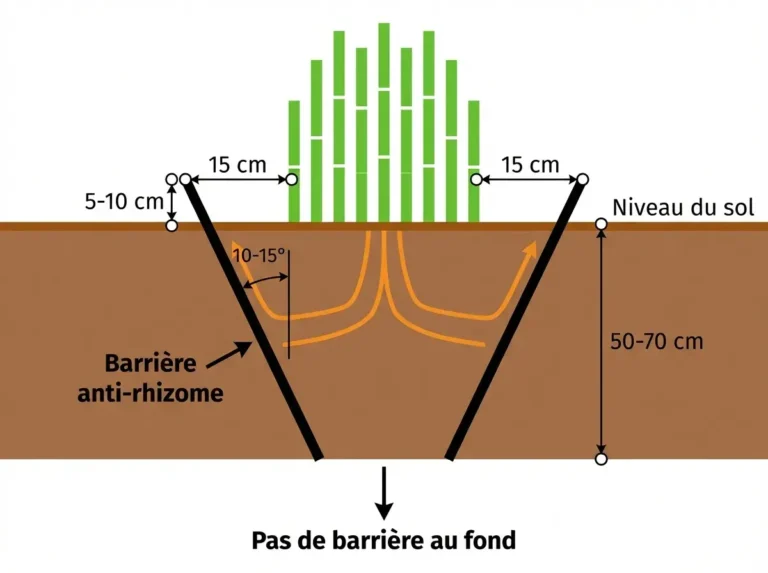
Controlling a running bamboo
Before any planting, secure control of the rhizomes: it is confidence point no. 1.