Paulownia groats, quality criteria, cutting schedule, precautions
Paulownia log: quality criteria, felling calendar, precautions
Short answer: a paulownia log is valued mainly on three points: the diameter, the length of knot-free log and the absence of defects (curvature, forks, splits, attacks). The felling calendar is managed as in the timber industry: dormancy, firm ground and prompt protection against end splits.
Paulownia is a light wood, often aimed at furniture, plywood and panel products. Quality is built on the standing tree: stem management, pruning and stress management (water, wind, late frost).
What a log is, and what the buyer is looking for
A log is a felled trunk, cut into log sections, before sawing. In practice, the buyer pays for a log for its usable share. This share is judged by volume, but also by defects.
Quality grading of roundwood typically relies on: diameter, length, knots, curvature, ovality, splits, rot and insect attack.
These criteria are used in technical references (roundwood) and in European studies, notably through poplar grading grids (industry reference).
Summary table: log quality and actions
At a glance
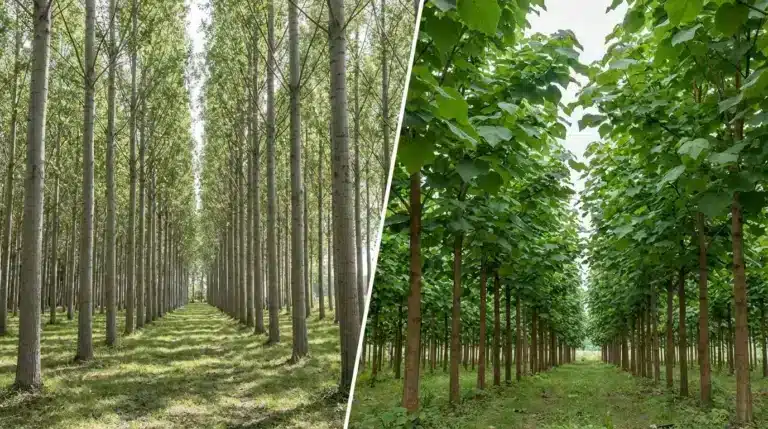
A premium log is a butt log that is long, straight and knot-free. The rest (forks, thin sections, branchy wood) quickly drops into panels, biomass or low value.
Download
You can export the table as a CSV to analyse it, index it or use it in AI tools.
If your WordPress editor blocks scripts, copy the table into Excel and export it as CSV.
| Criterion | How to check | Target (order of magnitude) | Impact on price | Work needed to get there | Defects to avoid |
|---|---|---|---|---|---|
| Diameter of the butt log | Measure the diameter (at 1.30 m and at the middle of the log section). Note the ovality. | The bigger, the better. Aim for a “sawlog” rather than “small wood”. | Direct effect on volume and on outlets (sawing, panels). | Water and nutrient management. Limit water stress. Choose a free-draining site. | Asphyxiation, standing water, irregular growth. |
| Usable length | Measure the usable length (butt log, then the following log sections). | Often 2.5 to 3 m in industry. Longer for a specific outlet. | Length = better sawing yield and fewer losses. | Progressive pruning. Selection of a dominant stem. Avoid forks. | Low forks, loss of dominance, scaffold limbs too low. |
| Knots | Observe the size and frequency of knots. Check healing. | Cleanest possible butt log (aim for “knot-free” over several metres). | A knot downgrades quickly: cracks, degraded appearance. | Prune as early as possible (year 2-3), regularly. Raise the pruning height progressively. | Late pruning, large branches, wounds, poorly sharpened tools. |
| Straightness and curvature | Assess the sweep (curvature). Check straightness along the log. | Straight trunk, low taper. | Curvature = sawing losses, lower yield. | Wind protection. Suitable density. Staking at the start if necessary. | Drying wind, lasting lean, unstable apical dominance. |
| Splits and checks | Inspect the ends of the log sections and the surface. Note any cracks. | As few as possible. End splits appear quickly if the ends are not protected. | Downgrading and loss of length (re-cutting). | Apply an end sealer (wax/emulsion) quickly. Store in the shade, off the ground. | Wood in full sun, unprotected ends, storage on the ground. |
| Rot and attacks | Observe colouring, soft areas, galleries. Check for abnormal smell. | Sound log, no active attacks. | Rapid downgrading. Volume losses. | Felling in dormancy. Rapid removal of the wood. Ventilated storage, off the ground, covered. | Long storage in the warm season, standing moisture, ground contact. |
| Stains and discolouration | Check for marks, blue stain, reactions on contact with metal/water. | Light, uniform appearance if the objective is furniture. | Stains = loss of value for visible uses. | Avoid felling in full growth. Reduce the delay from felling to sawing. Clean drying. | Moisture + heat, storage that is too long, contact with rusty iron. |
Felling calendar: when to fell, and why
The simplest window: late autumn to early spring. After leaf fall. Before sap flow resumes (bud burst).
Typical window (France)
November to March. Often more comfortable between December and February, if the ground is firm.
Why avoid the full growing season
The risk of stains and reactions in the wood increases with heat and humidity. As a precaution, favour felling in dormancy, especially if the aim is “visible” wood.
- Timber objective: dormancy + firm ground + logistics to get the wood out quickly.
- Biomass (SRC) objective: same logic, but bearing capacity and mechanisation dominate.
- If you coppice: formative coppicing and SRC coppicing are not the same thing. Adjust to the cycle.
Precautions after felling: splits, stains, storage
1) Protect the ends against splits
End splits appear quickly. The most effective solution is an end sealer (wax/emulsion) applied as soon as possible.
- Apply the sealer to both cut faces.
- Limit direct sun on the ends.
- Avoid hot, dry draughts on the end faces.
2) Reduce the risk of stains and blue stain
The risk increases with: heat, humidity, long time before sawing. If you are aiming for furniture/plywood, timing matters.
- Get the logs out of the plot quickly.
- Store off the ground, on spacers, with ventilation.
- Protect from direct rain without enclosing (unglued tarpaulin).
3) The pragmatic rule
The longer the wood waits, the higher the risk of degradation. If your outlet is “sawing”, fix a sawmill schedule before felling.
Work on the standing tree to maximise quality
Stem management and pruning
Value is made on the standing tree. A clean log is manufactured.
- Start pruning early (year 2-3) and follow up regularly.
- Avoid sudden heavy cuts: raise the pruning height progressively.
- Favour a dominant stem and remove competitors if necessary.
Stress management (water, soil, wind)
A stressed paulownia develops defects: more branching, more forks, irregular growth.
- Free-draining soil. No waterlogging.
- Access to water in the first years if quality is the objective.
- Windbreak if the plot is exposed.
Uses and consistency with your objective
A quality log opens up higher-value uses. A branchy log quickly drops towards lower-paying outlets.
“Visible” uses
Furniture, panels, plywood, light elements. A clean log is critical.
“Volume” uses
Biomass, chips, some panels. Visual quality matters less, logistics matter more.
To find out more: paulownia short rotation coppice and paulownia firewood.
Plants and resources
To choose the variety and management, start from the plot and the objective.
Guides: when to plant · where to plant · growth in France · invasiveness risk · paulownia hub
FAQ
What is the best time to fell paulownia for timber?
Late autumn to late winter: after leaf fall and before sap flow resumes. It is also the simplest period for limiting some staining risks, especially if the wood is intended for visible uses.
Should logs be debarked?
Not systematically. The key point is the time before sawing and the storage conditions. If storage is long in mild weather, the risk of degradation increases: decide with the sawmill.
How can end splits be limited?
Apply an end sealer (wax/emulsion) quickly, store in the shade and avoid direct sun on the end faces.
What downgrades a log the fastest?
Knots (and their size), curvature, forks, splits, rot and insect attack. These are the classic criteria of roundwood quality grading.