Soil and Drainage for Paulownia: Successful Planting (Technical Guide)
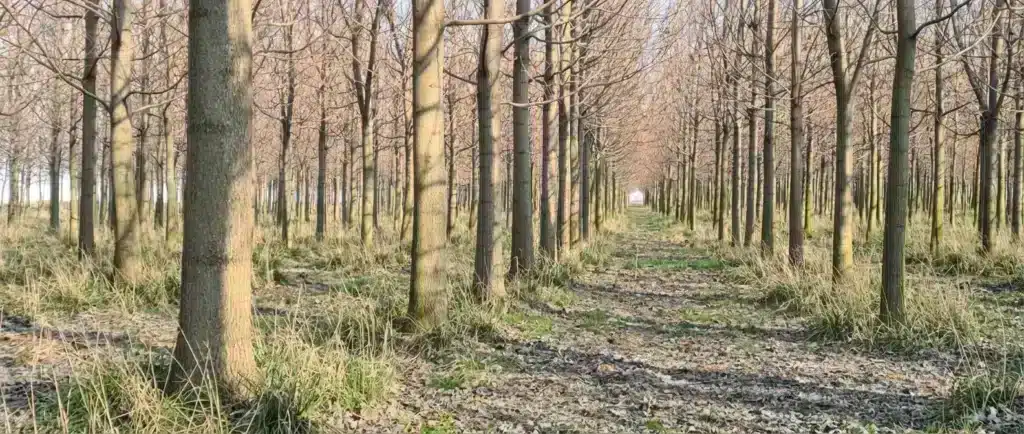
Soil and Drainage for Paulownia: getting your plantation right
The paulownia has an Achilles heel: root asphyxiation. Unlike willow, it does not tolerate standing water. A rigorous soil analysis is the key to profitability. Here are the 3 field indicators to check: texture, drainage and pH.
The 3 pillars of soil diagnosis
Before ordering your plants, check these three criteria. If any one of them is in the “red”, the risk of mortality or stunting exceeds 50%.
Paulownia needs an airy soil (sandy loam). Clay is the enemy it swells, compacts the soil and asphyxiates the taproot.
Water must be able to move through. The water table must be more than 1.5 m deep. Immersion of the roots in winter is fatal (rot).
Tolerant but precise. Ideal pH between 6.0 and 7.5. Above 8.0, there is a risk of iron chlorosis (yellow leaves) through iron lock-up.
Table of decision thresholds
Use this table to classify your parcel. A “Red” box rules out Paulownia (but may suit other biomass crops).
| Criterion | Ideal (Green light) | Risky (Orange) | Prohibitive (Red) | Agribiomix advice |
|---|---|---|---|---|
| Texture (% Clay) | Sandy loam (< 20%) | Clay loam (20-30%) | Heavy clay (> 35%) | Do the sausage test. If clayey: planting on a ridge is compulsory. |
| Soil depth | > 2 metres | 1 metre | < 60 cm (bedrock) | Deep subsoiling essential in autumn. |
| Water table (Winter) | > 2 metres | 1.5 metres | < 1 metre | If the water table is high: turn to willow or poplar. |
| pH (Acidity) | 6.5 – 7.5 | 5.5 – 8.0 | < 5.0 or > 8.5 | pH > 8: risk of chlorosis. Iron chelates can be applied but are costly. |
| Slope | < 5% (Flat) | 15-20% | > 25% | Slope helps drainage (a good point) but complicates mechanisation. |
Preparation and “rescue” techniques
1. Subsoiling (The basics)
To be carried out in autumn, on dry soil (so that the soil shatters). The aim is to break the “plough pan” created by farm machinery, which acts like an impermeable floor at 30cm depth.
2. Planting on a Ridge (For borderline soils)
If your soil is “borderline” (clayey or water table at 1.2m), do not plant flat. Build a ridge of 30 to 40cm (asparagus-style). Advantage: The root collar and first roots stay dry and warm, ensuring an explosive start in spring before the roots reach the deeper layers.
Raw technical data
Summary of agronomic parameters for your technical files or grant applications.
Show the data in CSV format
criterion,ideal,risk,prohibitive,corrective_action
clay_texture,sandy-loam (<20%),20-30%,>35%,ridge_planting
soil_depth,>200cm,100cm,<60cm,cross_subsoiling
winter_water_table,>200cm,150cm,<100cm,drainage_or_change_of_species
ph,6.0-7.5,5.5-8.0,<5.0_or_>8.5,lime_amendment_or_chelate
salinity_conductivity,<2dS/m,2-4dS/m,>4dS/m,soil_leaching_if_possible
Frequently asked questions (Soil FAQ)
How can I tell if my land is too clayey?
Do the “sausage test”. Take a handful of damp soil and roll it out. If you can make a ring without it breaking, the clay content is too high (>30%) for Paulownia. The risk of asphyxiation is major.
My land is flooded for 2 weeks a year: is that serious?
Yes. In dormancy (winter), Paulownia tolerates water for a few days. But during the growing season, or if water stands for more than 4-5 days, the roots rot (Phytophthora). Favour poplar in these areas.
Should I apply fertiliser at planting?
Not in the planting hole (risk of root burn). Favour a well-loosened soil. Fertilisation (nitrogen) is done on the surface, once the tree has got going (20cm leaves).
Need a personalised diagnosis?
Send us your soil analyses. We will guide you towards the most profitable species (Paulownia, Miscanthus, Willow).