Listebambou: search engine for 300 varieties of bamboo
ListeBambou: a tool to select a bamboo variety according to your use
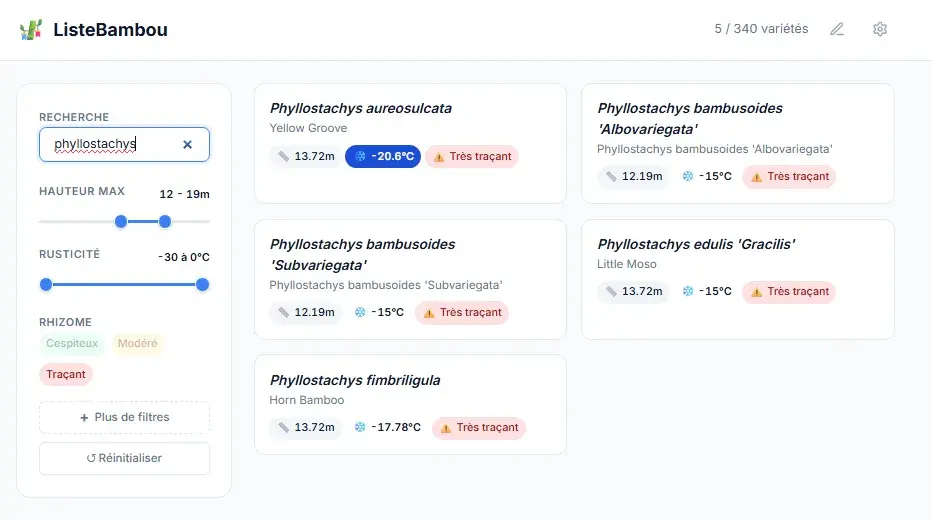
The success of a bamboo plantation depends largely on the choice of variety: height, hardiness, diameter and rhizome behaviour. ListeBambou is a comparison tool that helps you filter and compare varieties quickly, whether the aim is a privacy hedge, a potted bamboo, or an agricultural bamboo project.
Features: filter and compare
The interface offers decision-oriented filters, to reduce the list of varieties to those that match your situation.
Search and main filters
You can search for a variety by name, then filter by maximum height and hardiness (minimum temperature).
- Maximum height: suited to a bamboo hedge (privacy screen) or to a production approach.
- Hardiness: useful for securing a plantation in a cold climate.
Rhizome and type
The comparison tool distinguishes rhizome behaviours (clumping, moderate, running) and type (clumper / runner).
- Clumping bamboo : often sought for residential projects.
- Running bamboo : relevant when vigour and fast coverage are sought.
“Use” filter
A “use” filter lets you orient the sorting according to the objective: hedge, pot, or more productive profiles.
- Potted bamboo : constraints of root volume and watering.
- Agricultural bamboo : a search for vigour, diameter and biomass.
The information is provided for guidance only, and we recommend validating it with our team before purchase.
Key criteria according to your objective
For an effective selection, it is recommended to prioritise the technical criteria before the aesthetic ones.
Bamboo hedge (privacy screen)
Priorities: useful height, visual density, hardiness. The type of rhizome determines the level of control to plan for.
Potted bamboo
Priorities: development compatible with the container, tolerance of relative drought, manageable maintenance needs.
Bamboo crop (production)
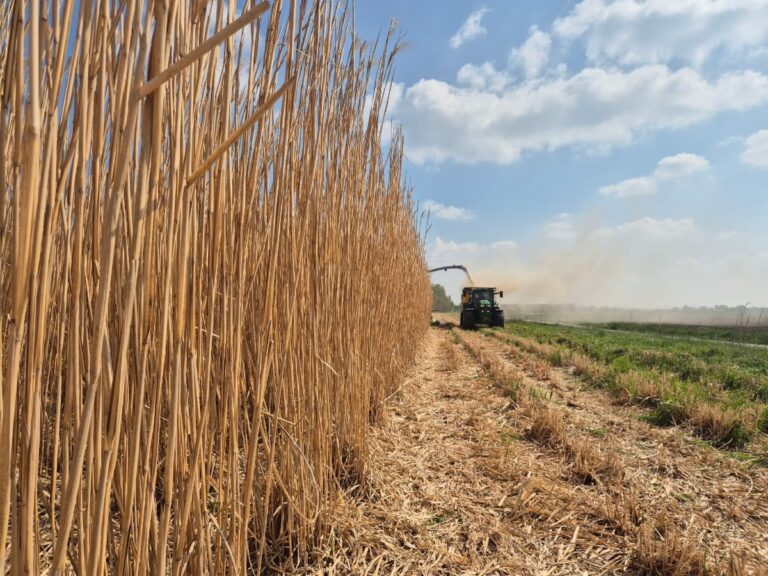
Priorities: vigour, speed of establishment, diameter and biomass potential. In this setting, certain running profiles are consistent provided that management of the spread is planned.
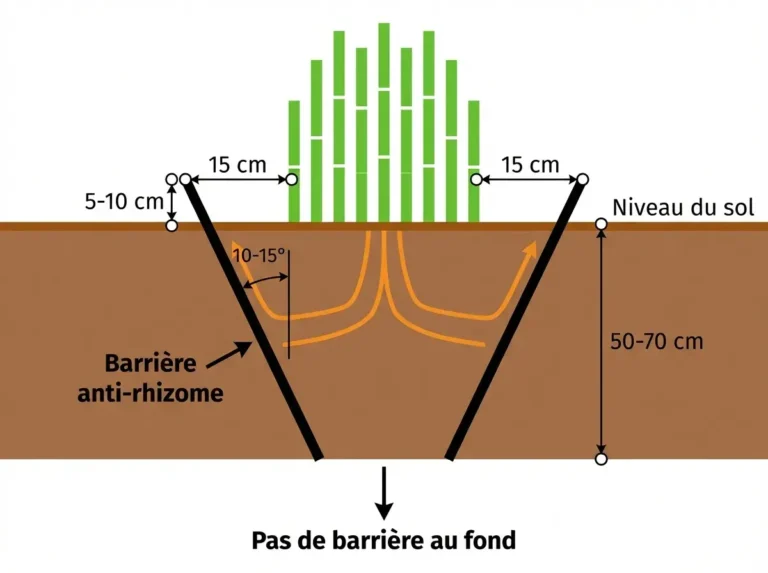
The running habit should not be interpreted as a flaw. For a project oriented towards biomass, speed of coverage or cane production, a running bamboo can be a rational choice, provided that a containment strategy is defined (borders, buffer zone, control trench, barrier if necessary).
Rhizomes: practical implications
The type of rhizome influences the ground footprint, the dynamics of colonisation and maintenance practices.
Clumping (tuft)
Compact growth, more predictable footprint. Often chosen for gardens and projects requiring simple control (e.g. Fargesia bamboo, depending on variety).
Moderately running
Progressive expansion. Of interest for a fast hedge while remaining manageable with regular monitoring.
Vigorously running
Profile frequently sought when vigour is the aim (e.g. certain “moso bamboo” or phyllostachys, depending on context). Management is prepared from the design stage.
Uses: what the tool saves you
The comparison tool reduces pre-selection time, and makes choices more reliable by imposing a reading sequence of “climate → rhizome → height → use”.
Hedge bamboo
You target a height and a hardiness, then you decide between “clumping bamboo” and “running bamboo” according to your capacity for management.
Potted bamboo
You eliminate the varieties that are too vigorous, and you focus the shortlist on profiles compatible with a container.
Agricultural bamboo
You quickly identify production-oriented profiles (vigour, diameter, biomass), then you organise the strategy for controlling the spread.
Taking action: selection, then purchase
Once 2 to 3 varieties have been selected, the priority becomes the quality of the plants and the conditions for establishment (logistics, root condition, planting calendar).
To order, see the dedicated page: bamboo plants.
For a bamboo grove or a bamboo cultivation project, it is recommended to validate the varietal characteristics with our team and to adapt to the local context (soil, climate, exposure).