
Agribiomix nursery · Northern France
Growing giant reed (Arundo donax): planting, yield, uses
Privacy hedge, mulch, biomass for a boiler or an anaerobic digester: giant reed is a giant grass with many uses. Here is where to plant it, how to establish it, when to harvest it and what it yields in your climate.
- 3 to 5 mmature height, with canes 2 to 3 cm in diameter
- 1 plant/m²or 10,000 plants per hectare for a biomass plot
- Year 2first harvest, then a harvest at the end of each winter
- May-Junethe best planting period, after the last frosts
A giant grass that regrows every spring
Giant reed (Arundo donax), also known as Provence cane, is a perennial grass, like maize or miscanthus. It forms a clump of rhizomes from which hollow, lignified canes covered in long leaves grow every spring. It does not produce viable seed in most regions: it is propagated by its rhizomes or by stem cuttings.
In autumn, the nutrients move back down into the rhizomes. In winter, the leaves dry out but the canes remain standing: the hedge keeps its privacy screening effect, and the plot is harvested dry at the end of winter.
- Growth: very fast, from May to October.
- Lifespan: monitored trials show 10 to 17 years of production from the same clump, with a peak as early as the 2nd or 3rd year.
- Cold: the clump overwinters dormant. In a trial in Slovakia, under a continental climate, no plants were lost at establishment or over winter; it also grows in the Berlin Botanical Garden. Late spring frosts are the real risk for young shoots.
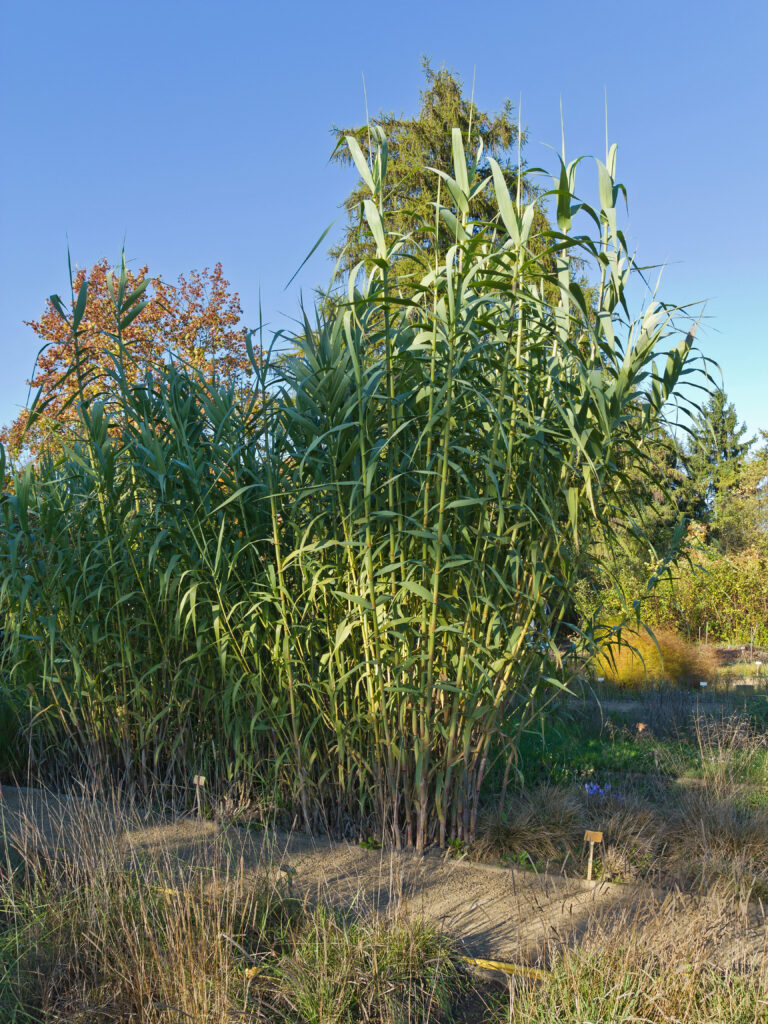
Where to plant giant reed
Moist, deep soil
The right site
It grows in all soils, clay and sandy alike, of pH 5 to 8.7. The best yield comes from a moist, deep, well-drained soil. It tolerates a little salt, with a yield loss of 12% at 5 dS/m.
Full sun
The right exposure
It loves warmth: the hotter and longer the summer, the more it produces. In northern France, give it a plot with good sun exposure, sheltered from late frosts.
Away from water
Places to avoid
Never beside a watercourse, a water-filled ditch or a pond, nor in a flood zone: floods carry away clump fragments that take root again further away. Our detailed recommendations: planting giant reed safely (in French).
Planting giant reed: the method
Plant in May or June, once the last frosts are over, in warmed soil. Plants already rooted in pots establish better than laboratory plants: in the Slovak trial, cuttings raised in pots gave 7.5 kg of dry matter per plant in the 4th year, compared with 5.1 kg for plants raised by in vitro culture.
- Prepare the soil: deep cultivation, then a fine, clean soil. Weeds are the weak point of establishment: start from a weed-free plot.
- Stick to the density: 1 plant per m² in a biomass plot, or 10,000 plants per hectare; for a hedge, 1 plant every 80 cm to 1 m along the row.
- Plant and water: root ball level with the ground, firmed in well, then water generously. In the first year, watering is essential for establishment.
- Plan a barrier in the garden: the clump widens every year. In a flower bed or a small garden, install an anti-rhizome barrier, as for a running bamboo.
Care and harvest
- First year: watering in dry periods and weeding, until the canes cover the ground.
- Following years: the plant needs little. Once established, it seeks out water at depth and needs no watering, except in severe drought, which reduces yield. Fertilisation increases it markedly in the Italian trials.
- Harvest: once a year from the 2nd year, at the end of winter, when the stems have dried standing. In Slovakia, canes harvested in March had a moisture content of 31 to 43%. The stems are tall and hard: tell us about your equipment before planting a large area.
- Edges: every year, cut any shoots that grow beyond the planted area, and leave no clump waste in the wild.
- Returning the land to cultivation: a clump is destroyed by milling the soil in several passes, then covering it with black plastic sheeting for at least 6 months. This method eliminated 100% of the rhizomes in a trial in the Hérault department of southern France.
Yield by climate
Giant reed is very productive in a hot climate and markedly less so in a cool one. No yield measured in France has been published to date. For a project in northern France, we recommend planning on between 6 and 25 t of dry matter per hectare per year depending on the soil and the summer, and keeping the Italian figures as a ceiling.
| Trial | Climate | Dry matter |
|---|---|---|
| Central Italy, 12-year trial | Mediterranean | 37 to 40 t/ha/year on average, peaking at about 50 t in the 2nd and 3rd year |
| Rhineland (Germany), 1996 | cool temperate | 5.8 t/ha, climate judged non-optimal by the authors |
Yield rises over the first two or three years, then levels off; in Slovakia, without irrigation or fertiliser, production per plant increased every year from the 2nd to the 4th. Plants at the edge of a plot produce almost twice as much as those in the centre: in a hedge, each plant therefore produces more. To compare with the other crops on the same criteria, use our biomass crop comparison tool.
Uses of giant reed
From the 2nd year
Privacy and windbreak hedge
An opaque wall of vegetation 3 to 5 m high, which keeps its canes standing in winter and lets a little light through in the cold season. For an evergreen hedge, compare with bamboo.
End of winter
Mulch
Shredded at the end of winter, the dry stems make a carbon-rich mulch that breaks down slowly, for the vegetable garden and flower beds. Managed in the same way as miscanthus mulch.
Boiler, anaerobic digester
Energy biomass
When burned, its ash content is 3 to 6% of the dry matter: a high level, to be checked with your boiler. It can also be used for anaerobic digestion, and Italy is studying it as an alternative to silage maize.
Canes
Materials
Plant stakes, garden canes, reeds for wind instruments: this is the oldest use. Particleboard made from giant reed has been tested in Spain.
Polluted soils
Phytopurification
It tolerates polluted soils and contaminated water: it is a plant widely studied in phytoremediation. See our phytopurification plants.
Giant grasses
Or giant miscanthus?
Sterile, more cold-hardy and proven in France at 13 to 20 t of dry matter per hectare, giant miscanthus remains our first recommendation for a biomass plot in northern France.
Our plants and services
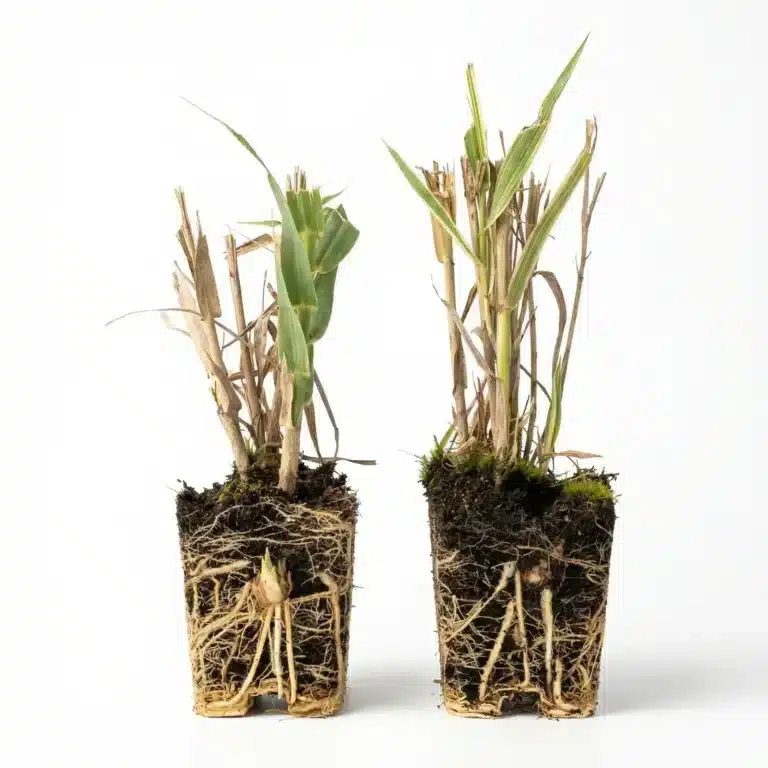
Giant reed in P9 pots
One-year-old plants, established roots, establishment guaranteed, tiered pricing according to quantity.
View the plants →
Planting safely
What the regulations say, and our precautions to keep it within the plot.
Read the article (in French) →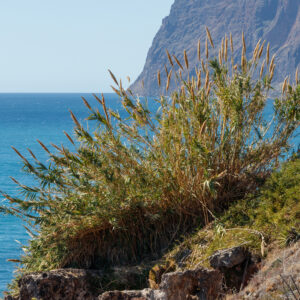
A tailor-made project
Hedge or plot: we calculate the number of plants and the density for your site.
Contact us →Frequently asked questions about growing giant reed
When should giant reed be planted?
In May or June, once the last frosts are over, in warmed soil. Water generously at planting and throughout the first summer.
How many plants per hectare?
We recommend 1 plant per m², or 10,000 plants per hectare, for a biomass plot. For a hedge, 1 plant every 80 cm to 1 m along the row.
What yield can be expected in northern France?
No French yield has been published. We recommend planning on between 6 and 25 t of dry matter per hectare per year depending on the soil and the summer; the 37 to 40 t from the Italian trials remain a ceiling for a hot climate.
Does it withstand the cold?
The clump overwinters dormant and starts growing again in spring; the canes dry out and remain standing. In a trial in Slovakia, under a continental climate, no plants were lost over winter. Protect young shoots from late spring frosts.
Does it need watering?
Yes, in the first year, to help it establish. After that, it seeks out water at depth; a severe drought reduces yield but does not kill it.
When should giant reed be harvested?
Once a year, from the 2nd year, at the end of winter, when the stems have dried standing: their moisture content is then 31 to 43%.
Giant reed or giant miscanthus?
Giant reed produces more in a hot climate, and its hard stems also serve as a material. In northern France, giant miscanthus, sterile and proven in France, remains the safest choice for a biomass plot.
Is it invasive?
It does not self-seed, but its clump fragments take root again: never plant it beside water. The regulations and our precautions are detailed in our article Is giant reed invasive? (in French).
Sources
Gubišová, Gubiš and Žofajová (2016), biomass production of Arundo donax and Miscanthus × giganteus by propagation method, journal Agriculture (Slovakia); Angelini et al. (2009), Biomass and Bioenergy, 12-year trial in Italy; Schwarz et al. (1997), trials in North Rhine-Westphalia; Fabbrini et al. (2018), GCB Bioenergy; Corinzia et al. (2021), European Biomass Conference; Pari et al. (2009), CRA-ING; Lino et al. (2023), Heliyon; Kato-Noguchi (2025), Plants; Ferrández-García et al. (2020), Polymers, particleboards; Barthod and Boyer (2017), field report on the mechanised removal of giant reed, Hérault. Header photo: giant reed in Funchal (Madeira), H. Zell, CC BY-SA 3.0, Wikimedia Commons. Consulted: 3 November 2026.
Planning a giant reed hedge or plot?
Tell us the length or area, the soil and the intended use: we will suggest the density and the number of plants.