
Agribiomix nursery · Northern France
Basket willow: growing your own osier
Osier is made up of the one-year-old stems of willows grown in an osier bed, cut in winter and then prepared as brown, white or buff willow. Here is how to choose your willows, plant an osier bed, harvest and store osier, and build a living willow structure successfully.
- 20 to 30 cmthe length of a willow cutting; ours are 20 to 22 cm
- December-Februarythe osier harvest, while the plants are dormant
- 8 to 10 tof green willow per hectare per year once the osier bed is established
- 15 to 30 yearsthe lifespan of a well-maintained osier bed, depending on the source
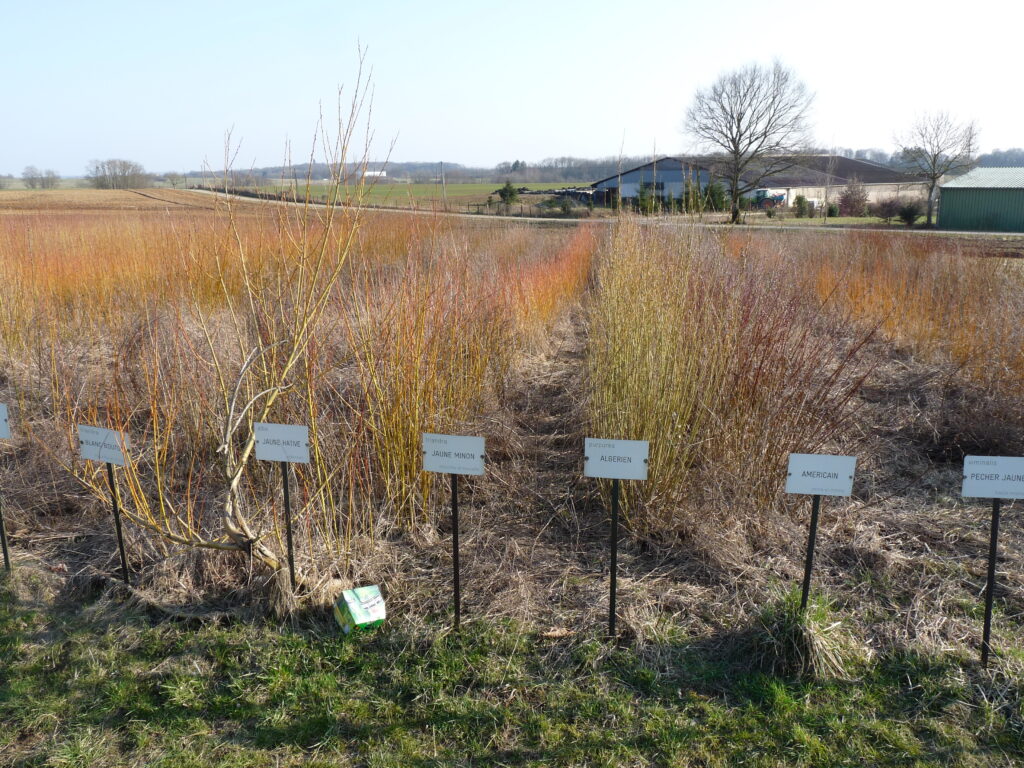
Which willow for which osier?
Osier refers to the annual rods of willows grown for basketry. The most widely used species are Salix viminalis (basket willow), Salix purpurea and Salix triandra, together with Salix alba and Salix fragilis. Europe has some sixty species of willow.
- Fine basketry: long, fine, even rods.
- Woven hurdles, fences, structures: sturdy varieties with thicker rods.
- Hedges, huts, living willow weaving: vigorous willows that take root easily.
Salix purpurea, with red or purple bark, is much sought after by basket makers; Salix triandra is traditionally used for white willow. The right choice also depends on your land: a few trial plants before planting on a large scale will spare you unpleasant surprises.
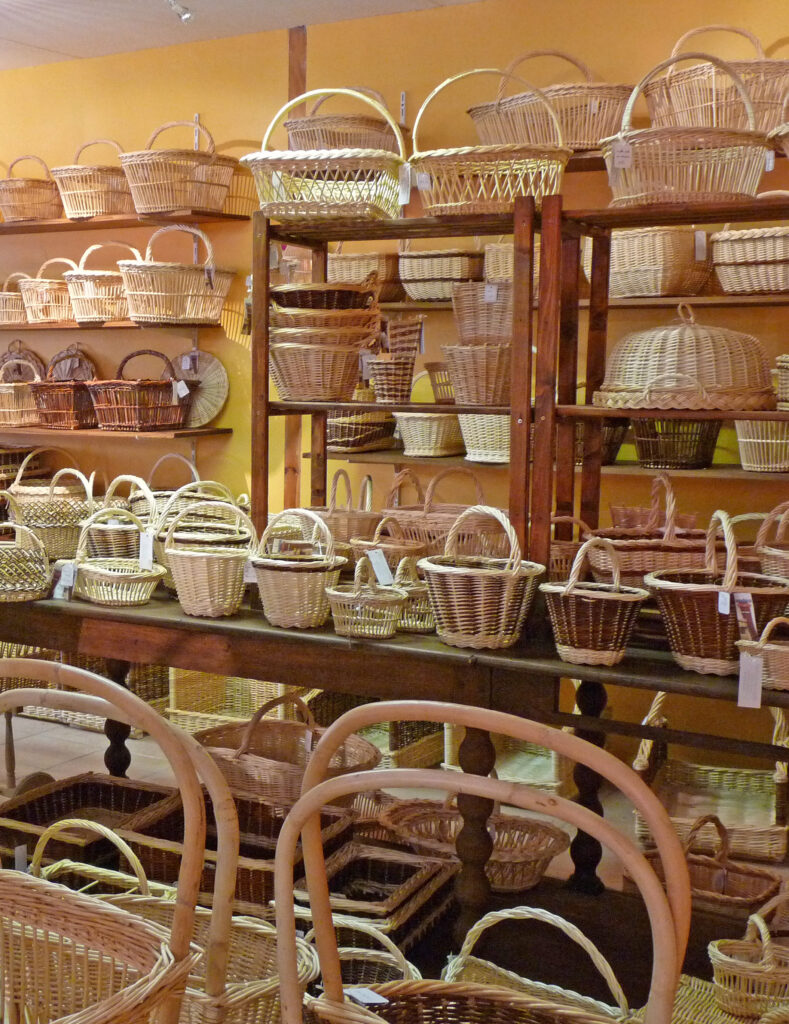
Choosing and preparing the site
- The ideal soil: deep and fertile, holding water while still draining; a silty clay loam or an alluvial soil, pH 6 to 7.5. A soil analysis is recommended.
- To avoid: shallow soil, very calcareous soil, acid peat, waterlogged ground.
- Preparation: ploughing 25 to 35 cm deep, then careful weeding before planting: this is the most frequently cited success factor. Mulching helps a great deal on a small area.
- Quality before yield: too much water or fertiliser produces over-vigorous rods that are less pleasant to work.
Planting an osier bed: cuttings, timing, density
When? In late winter or early spring, outside frost periods; one source gives mid-January to March, when the soil reaches 5 °C. Our cuttings can be planted from autumn to the end of April. After 1 April, soak them in water for 24 hours before planting.
The cutting: a length of one-year-old shoot, 20 to 30 cm long, with the base cut at a slant. The minimum diameter varies by source, from 5 mm to 8-12 mm. Agribiomix cuttings are 20 to 22 cm long and the top end is painted white so that they are not planted upside down.
Planting depth: 15 to 20 cm in the ground, with 2 to 5 cm above ground (up to 25 cm deep in dry or exposed soil). Some practitioners bury the cutting completely. Keep cuttings cool (5 °C at most) and in the dark until they are planted.

| Your project | Planting density | Benchmark |
|---|---|---|
| Small osier patch for your own use | 3 to 10 cuttings per m² | a few tens of m² are enough to get started |
| Mechanised osier bed | 25,000 to 50,000 cuttings per hectare | rows approximately 0.6 to 0.8 m apart |
| Dense hand-planted osier bed | up to 100,000 to 120,000 per hectare | example: 15 cm in the row, 80 cm between rows ≈ 83,000/ha |
| Biomass coppice | about 45,000 cuttings per hectare | Agribiomix benchmark |
Densities vary by source and by use: close planting gives fine rods for basketry, wider planting gives thicker rods.
Managing the osier bed in the first years
- Weed control: hoe as soon as growth restarts in spring, especially in the first two to three years; on a small area, use mulch or woven fabric.
- Water: willow loves water. In a dry climate, summer watering may be needed (example in Provence: 3 to 4 waterings from May to July).
- First cut: the first year’s growth has no commercial value, but it is cut back to encourage good regrowth.
- Coming into production: first useful harvests from the 3rd season; full production between the 5th and 7th year according to one source.
- Health monitoring: watch for leaf beetles, reported in osier beds in the south of France.
Harvesting osier
- When: while the plants are dormant, from November-December to February-March, once the sap has gone down.
- How: with secateurs or a cutter bar, right down to the stump, every year. Cutting every 2 to 3 years gives thicker rods (poles).
- Grading: by length, in 20 cm bands, from 0.60 m to 2.40 m; the most requested lengths run from 1.20 to 1.60 m. Branched rods are set aside.
- Yield: 8 to 10 t of green willow per hectare per year, up to 12 t in good conditions; another source gives 7 to 10 t.
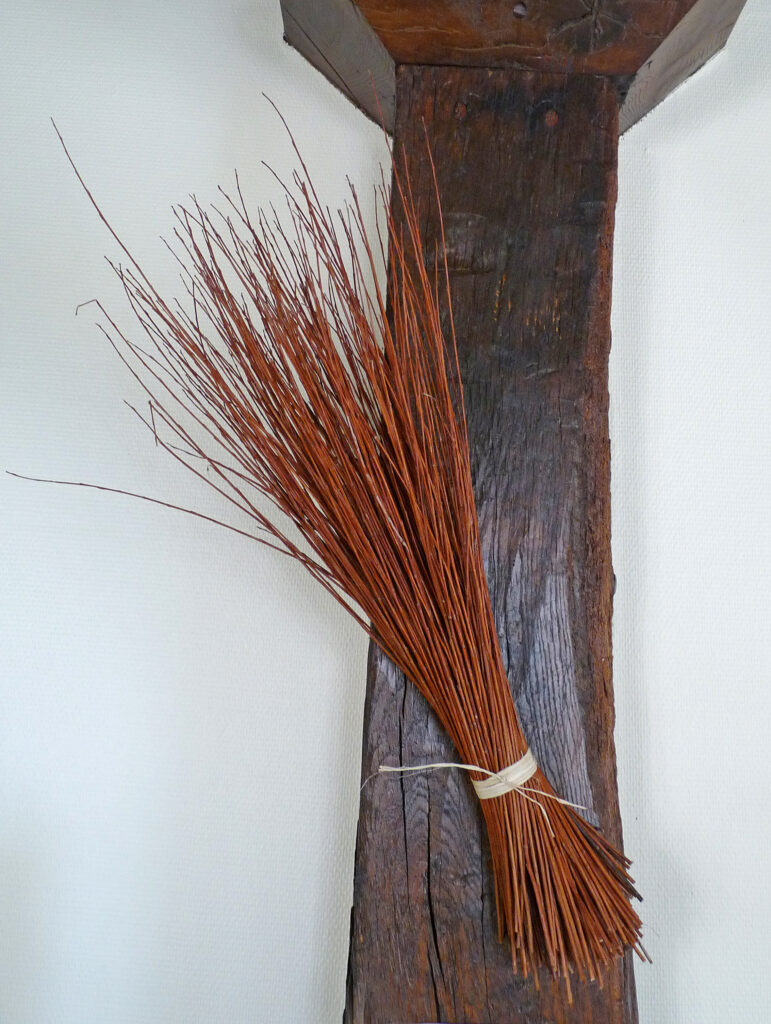
Green, brown, white or buff willow: preparing and storing
| Willow | What it is | Preparation and storage |
|---|---|---|
| Green | fresh osier, just cut | worked straight away; once dry, it has to be soaked |
| Brown | dried with its bark on | in upright, tied bundles, in a dry, airy place, sheltered from sun and rain, for a few weeks to 2-3 months; keeps for several years |
| White | peeled in spring | bundles stood upright in 10 to 20 cm of water (soaking pit) for 1 to 3 weeks, from March to April, until roots appear, then peeling with a willow brake and drying under cover; the only osier permitted in contact with food in France |
| Buff | brown willow cooked in boiling water | 2 to 3 hours according to one source, 8 to 10 hours according to another |
Soak before weaving: brown willow is soaked for about 5 days in summer (water above 20 °C) and up to 15 days in winter (water below 10 °C), or 1 to 4 weeks according to another source; white willow for only a few hours. If soaked too long, the rod starts to peel. In cold weather, use it within 10 to 15 days.
Living willow: woven hedges, huts and tunnels
Planted as fresh rods, willow takes root and can be woven: diamond-pattern hedge, dome hut, tepee or tunnel. The guideline figures below come from British, German, Austrian and Belgian public guides.
When and where
While the plants are dormant, from November to early March in most cases. A sunny, fairly cool spot, never under a tree. Clear the grass over 30 to 60 cm and mulch to a depth of at least 5 cm. The Royal Horticultural Society advises keeping at least 10 m away from buildings and drains.
The rods
Fresh, long, straight and free of side twigs: 1.5 to 2 m for a hut, 2 to 2.5 m for a tunnel. Two-year-old wood for the uprights, one-year-old wood for the weaving. Trim 10 cm off the base at a slant when planting.
Planting
Woven hedge: an upright about every 1 m, driven in about 30 cm, and an infill rod every 15 to 30 cm planted at 45°. Hut: a circle of 1 m radius, a rod every 15 to 30 cm, set 40 to 50 cm deep. Tunnel: two rows 0.8-1 m apart, a rod every 20 to 30 cm.
- Weaving: infill rods planted at 45°, half in one direction and half in the other, form diamonds; tie at every crossing (jute or thin willow), and the rods eventually fuse together. Never direct a shoot downwards: it dies.
- Watering: generously after planting, then according to dryness (from daily to weekly depending on the guides); the soil must stay moist for the first year, or even two.
- Maintenance: in late summer, weave the new shoots into the structure; trim anything that sticks out in autumn or winter. The following year, replace any rods that have not taken. Without maintenance, the structure turns back into a bush: willow can grow 2 m a year.
- Lifespan: a well-maintained tunnel can last a very long time, up to 40 years according to a guide from Flanders, provided it is trimmed every year.
Our cuttings and services
Basket willow (Salix viminalis)
Pack of 100 cuttings of 20 to 22 cm, prepared to order, with a white mark at the top of each cutting.
View the cuttings →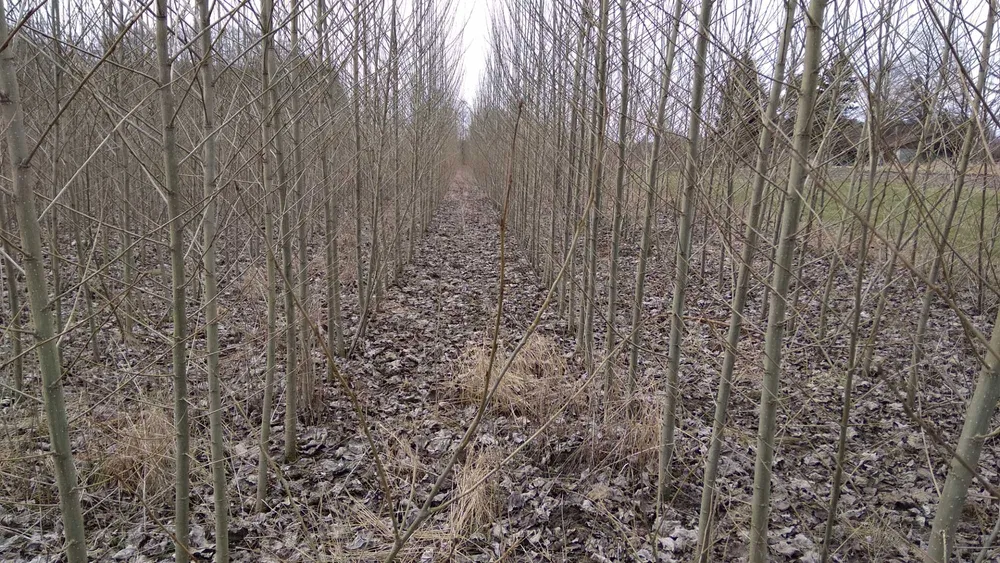
Biomass coppice
Willow and poplar short-rotation coppice for woodfuel: densities and management.
Poplar →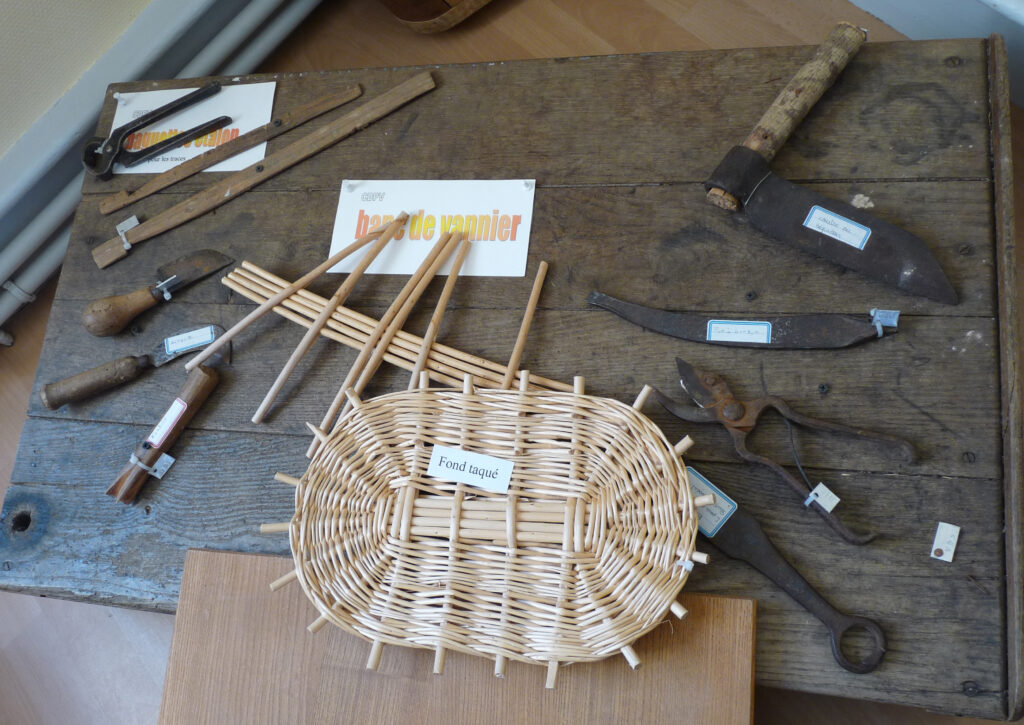
An osier bed project?
Number of cuttings, density by use, timing: tell us about your project. Photo: Ji-Elle, CC BY-SA 3.0.
Basket willow guide
Frequently asked questions about basket willow
When should willow cuttings be planted?
In late winter or early spring, outside frost periods; our cuttings can be planted from autumn to the end of April. After 1 April, soak them for 24 hours before planting.
What length of cutting, and how deep?
20 to 30 cm long, set 15 to 20 cm deep with 2 to 5 cm above ground. Our cuttings are 20 to 22 cm long.
How many cuttings should be planted?
3 to 10 per m² for a small osier patch; 25,000 to 50,000 per hectare in mechanised planting, up to 100,000 to 120,000 in dense hand planting.
When should osier be harvested, and how much can be expected?
In winter, usually from December to February. An established osier bed produces 8 to 10 t of green willow per hectare per year; first useful harvests from the 3rd season.
How should osier be dried and stored?
In upright, tied bundles, in a dry, airy place, sheltered from rain and sun, for a few weeks to 2-3 months. Dry brown willow keeps for several years.
How long should osier be soaked before weaving?
Brown willow: from 5 days in summer to 15 days in winter according to one source, 1 to 4 weeks according to another. White willow: a few hours.
Sources
No official French technical sheet on planting osier was found: this page summarises Belgian, Swiss, British, German, Austrian and association sources, consulted on 2 November 2026. Where they differ, we give the ranges.
- Filière Osier (Parc naturel Haute-Sûre Forêt d’Anlier, Belgium): creating a production osier bed, types of osier, harvesting brown willow, preparing white willow
- Vert Pomme asbl: small-scale willow growing
- WaldWissen (WSL, Switzerland): basketry with local woods
- M. Marjot (ESA Angers), Osier in Provence, 2020
- Royal Horticultural Society: living willow; Thrive: plant a living willow structure
- Stadt Münster: Bauen mit Weiden; Nationalpark Gesäuse: Der Weidendom; ProSpecieRara: Flechtweiden anbauen
- Vlaamse overheid: maak zelf een wilgenhut; renature.brussels: bouw een levende wilgenhut; Regionaal Landschap Schelde-Durme: draaiboek wilgenhutten
Ready to plant your osier bed?
Pack of 100 basket willow cuttings, delivered for the planting season.