
AGRIBIOMIX

haie de miscanthus

Miscanthus hedge: Fast-growing ecological privacy screen

Are you looking for a way to hide from the neighbors quickly, without waiting 10 years for your cedars or bamboo to grow? You don’t want to spend your weekends pruning anymore?

Miscanthus hedges (elephant grass) can grow up to 4 meters high in a single season once well established (2 to 3 years). This giant grass provides an impenetrable, modern and ultra-ecological plant screen.

Here’s Agribiomix’s complete guide to successful planting and our calculator to find out how many rhizomes to order.

Why choose Miscanthus Giganteus for your hedge?

The Miscanthus x giganteus is no ordinary plant. It’s a sterile (non-invasive) hybrid that breaks all records:

  1. Lightning speed: It starts from scratch in spring and reaches its adult size (3 to 4m) by July. It’s the fastest natural screen in the world.
  2. Perfect concealment: Dense canes and dense foliage protect from prying eyes and cut wind.
  3. Zero maintenance (or almost): No hedge trimming 3 times a year. Just one short cut in March, and that’s it.
  4. 4-season aesthetics: Lush green in summer, it dries out in autumn to take on a magnificent golden hue (straw) in winter, while remaining upright. It doesn’t shed its leaves: it’s marcescent.

When and how to plant your hedge?

Planting is done exclusively from rhizomes (roots), as giganteus seeds are sterile.

1. The ideal time

Plant your rhizomes between March and May, as soon as the hard frosts have passed and the soil is warming up. This is when the plant emerges from dormancy.

2. Soil preparation

Miscanthus is an all-terrain plant. It grows everywhere, except in permanently flooded soil.

  • Loosen the soil to a depth of 20 cm.
  • There’s no need to add chemical fertilizers. A little mature compost is all you need.

3. Distance and density (The Golden Rule)

For an effective privacy hedge, density is key.

  • Planting depth: Bury rhizome 7-10 cm deep.
  • Spacing: For a green wall, allow 1 metre between each plant if you’re patient, or 50 to 70 cm for immediate results in the first year.

Agribiomix tip: For maximum thickness (sound and visual), plant in staggered rows 50 cm apart.

🌱 Calculate your Miscanthus needs

m
You will need about : 40 rhizomes Order this lot 👉

Annual maintenance: 5 minutes a year

Forget the chore of pruning. The Miscanthus hedge lives its own cycle:

  1. Spring (March): The previous year’s canes are dry. Cut back the hedge to 10 cm from the ground using shears or a hedge trimmer.
  2. Mulching Bonus: Don’t throw away cut canes! Shred them (or cut them into pieces). You’ll get free , premium-quality mulch for your vegetable garden or flower beds. Nothing goes to waste.
  3. April: New green shoots emerge. The cycle begins again.

Frequently asked questions

Questions fréquentes sur la haie de Miscanthus

Le Miscanthus va-t-il envahir mon jardin comme le bambou ?
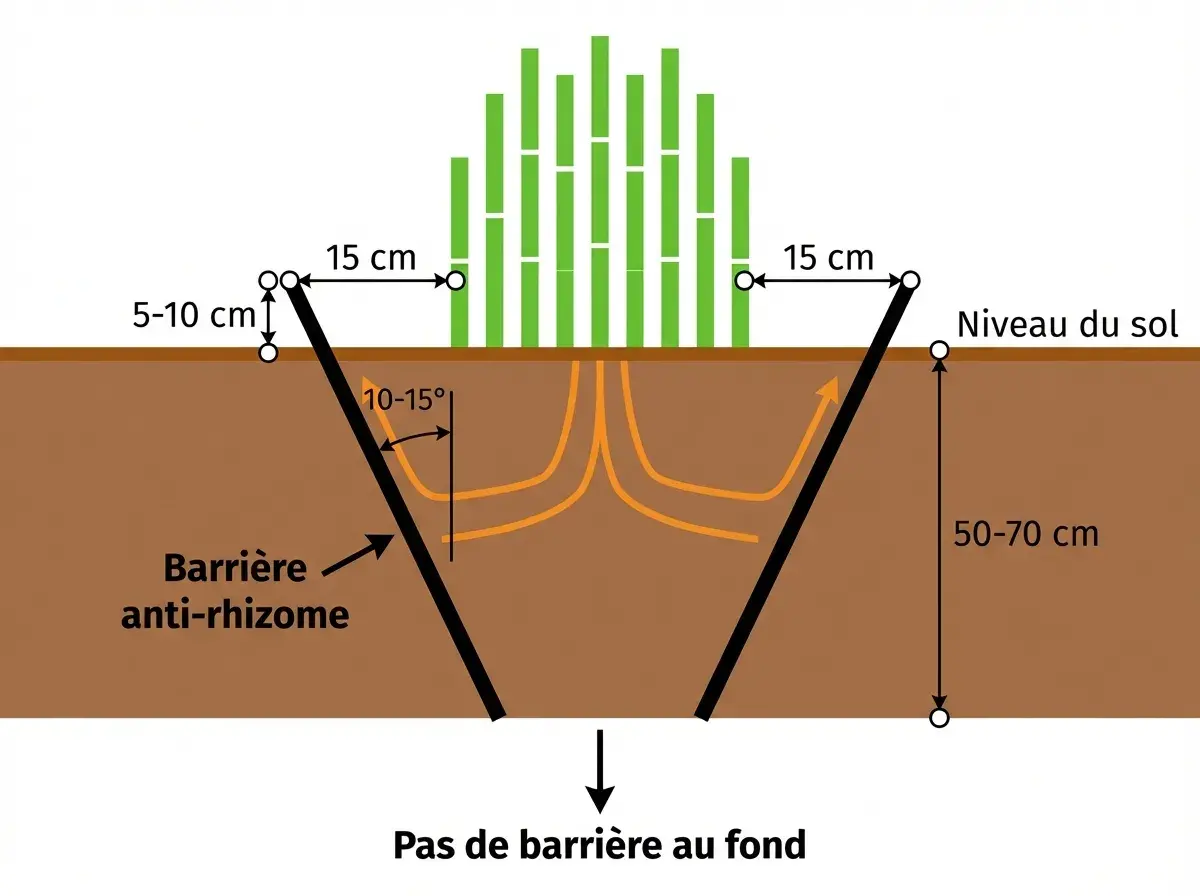
Non, absolument pas. Le Miscanthus x giganteus est une plante “cespiteuse” (qui pousse en touffe) et non “traçante”. Contrairement au bambou qui envoie des racines à 5 mètres, le Miscanthus reste sagement à sa place. Son diamètre augmente de 1 à 2 cm par an seulement. Vous n’avez pas besoin d’installer de barrière anti-racinaire.
Est-ce que ça pousse à l’ombre ou en terre humide ?
Le Miscanthus est très tolérant. Il accepte la plupart des sols, même argileux. Cependant, il a deux ennemis : l’ombre totale (il restera chétif) et l’eau stagnante permanente (type marécage). Pour une haie vigoureuse de 3 à 4 mètres, privilégiez une exposition ensoleillée ou mi-ombragée.
Combien de temps pour avoir une haie brise-vue efficace ?
C’est la plante la plus rapide du marché. Dès la première année, si vous plantez en mai, les tiges atteindront 1,50m à 2m en octobre. Dès la deuxième année, la haie atteindra sa taille adulte (3 à 4m) et sera suffisamment dense pour vous cacher complètement des voisins.
Que se passe-t-il en hiver ? La haie disparaît-elle ?
Non, la haie reste en place ! Le Miscanthus sèche à l’automne et prend une jolie teinte dorée (couleur paille), mais les cannes restent rigides et verticales tout l’hiver. Elles s’éclaircissent un peu mais continuent de jouer leur rôle de brise-vue et brise-vent. Vous ne couperez les cannes sèches qu’au mois de mars suivant, juste avant la repousse des nouvelles tiges vertes.
Pourquoi acheter des rhizomes plutôt que des graines ?
Attention aux arnaques ! Le vrai Miscanthus x giganteus est un hybride stérile. Il ne produit aucune graine viable. Si on vous vend des graines, ce n’est pas du Giganteus (mais souvent du Sinensis, plus petit et envahissant par semis). La seule méthode pour obtenir une vraie haie géante est de planter des rhizomes (racines).

Other articles