
AGRIBIOMIX

barrière anti-rhizome

Anti-rhizome bamboo barrier: installation to manage trailing bamboo

Bamboo rhizome barrier: the Guide to managing stalked bamboo

🛡️ Objective: contain the area 🧱 Priority: watertight junctions 📏 Benchmark: 60-70 cm minimum

An anti-rhizome barrier is used to define a perimeter. It frames the vigour of a trailing bamboo. The result depends above all on two points: continuity and the quality of the junctions.

Anti-rhizome barrier for bamboo: material and principle
Rhizome barrier: the aim is continuous containment.
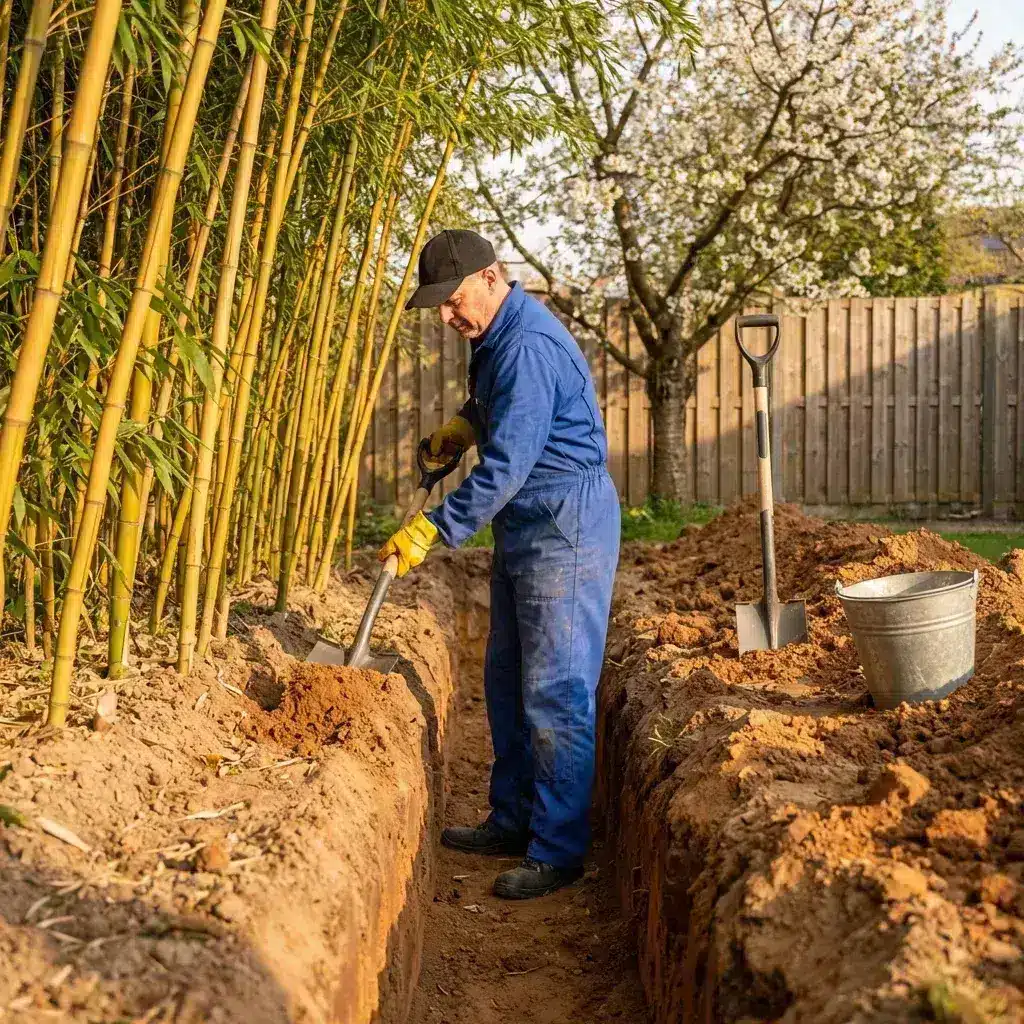
Installation of a rhizome barrier for trailing bamboo: trenching and laying
Installation: trenching, laying, joints, then careful backfilling.

If you’re planting near a property line, paving or pond, containment is essential. Otherwise, you transfer the risk to the neighborhood or to the structures.

1) Choose the right barrier

Recommended material

Aim for a smooth, waterproof high-density polyethylene (HDPE) barrier. This is the robust standard for trailing bamboo.

  • Thickness 1.5 mm (common) to 2.0 mm (more resistant).
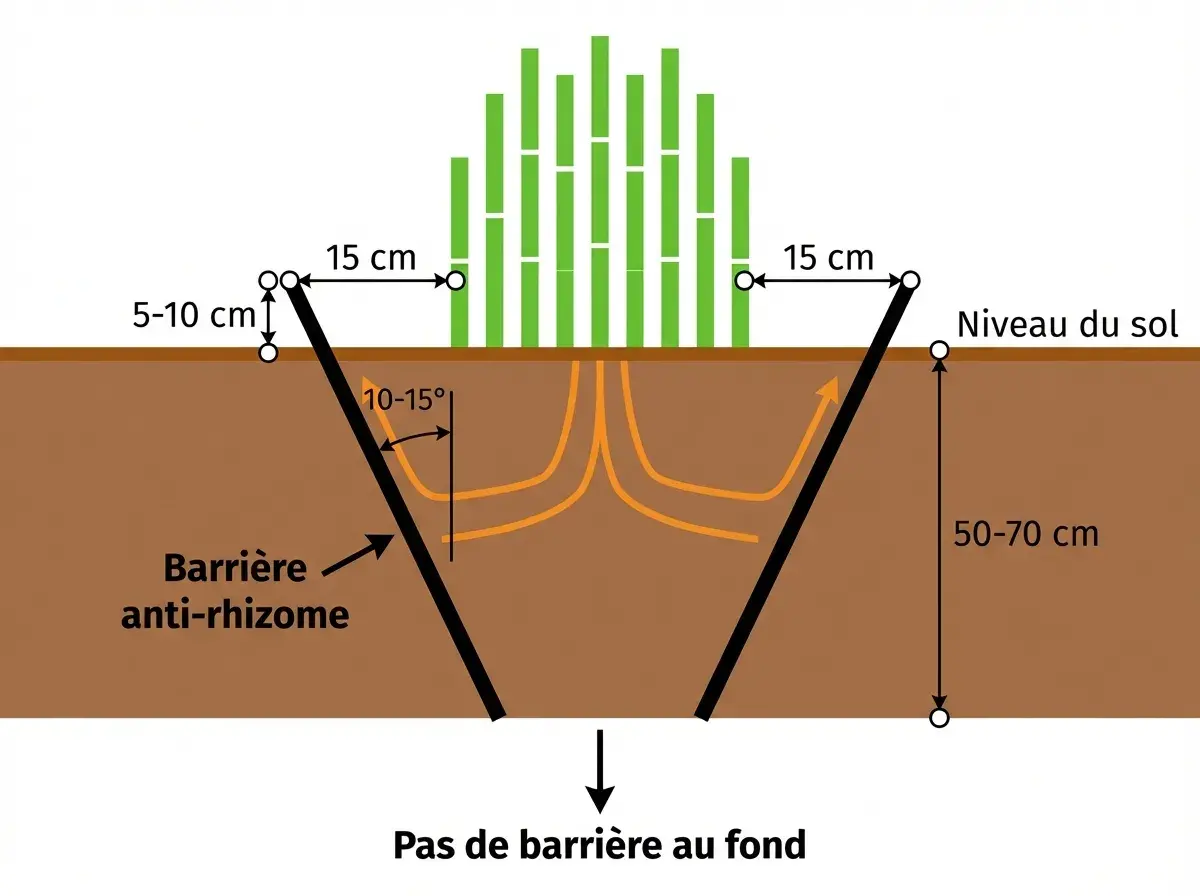
  • Height 60-70 cm (minimum). More if you over-secure.
  • Smooth surface = rhizomes are deflected and easier to spot.

Avoid

Don’t confuse a rhizome barrier with a garden textile. Textiles can filter and protect. It does not guarantee long-lasting rhizome containment.

  • Permeable textiles, fine fabrics, non-continuous materials.
  • Piece barriers with weak connections.
  • Tight corners and approximate junctions.

2) Sizing the confined area

Trailing bamboo needs a dedicated area. Too small an area increases pressure on the barrier and on the joints.

  • Simple benchmark: aim for an area at least 2.5 m in diameter for a large Phyllostachys.
  • Hedge: prefer a wide “corridor” to a narrow strip.
  • Sensitive projects: the more constrained the area, the more regular the inspection.

3) Depth, overrun and safety logic

Depth determines your safety margin. There is no “one” universal depth, but there are points of reference.

  • 60-70 cm: the most common working base.
  • ≈ 90 cm: enhanced safety (sensitive projects, easy-to-excavate ground).
  • Up to 1.2 m: very conservative approach (special cases).

Another useful guide is to leave the fence a few centimetres above the ground. You’re quicker to spot what’s trying to get out.

4) The golden rule: flawless joints

The majority of failures come from a junction that leaves a gap. A rhizome doesn’t need a big hole.

Methods used

  • Overlap: long overlap + fastening + sealing.
  • Mechanical connection: rail/clamp over height (if available and suitable).

Quality control

  • Continuous barrier: no break, no hole.
  • Solid joint: impossible to spread by hand.
  • Clean backfill: no folds, no pockets to create a weak point.

If a point is in doubt, correct before backfilling. After that, the trade-in costs more.

5) Step-by-step installation

  1. Draw the perimeter. Avoid tight angles. Provide a dedicated area.
  2. Open the trench. 60-70 cm minimum, more if sensitive project.
  3. Install the barrier. Continuous, with no weak points and only a few centimetres visible.
  4. Treat junctions. Watertight overlap or mechanical joint.
  5. Backfill and tamp. Without bending the gate. Check the joints one last time.
  6. Planting. Water at start-up. Keep an eye on the perimeter during the first year.

6) Regular checks: what you’re looking at

A barrier greatly reduces the risk. Regular monitoring ensures long-term results.

  • Once a year: complete perimeter inspection (spring or late summer).
  • Sensitive areas: junctions, wetlands, compacted areas.
  • If an exit appears, cut off the rhizome, then correct the weak area.

7) Neighborhood setting (France)

If rhizomes cross a dividing line, neighbors can take action. A frequently cited reference is article 673 of the French Civil Code (cutting at the dividing line).

Source: Article 673 of the French Civil Code (Légifrance)

Containment + control is also a choice for peace of mind.

Frequently asked questions

Is a barrier enough without controls?

It greatly reduces risk. Regular checks are especially important at junctions and sensitive areas.

Which depth to choose?

60-70 cm is a common benchmark. 90 cm increases the safety margin. Deeper is justified on sensitive projects.

Where can I find other articles (hedges, varieties, biomass)?

Bamboo file: https://agribiomix.com/bambou/

How do you choose the right variety?

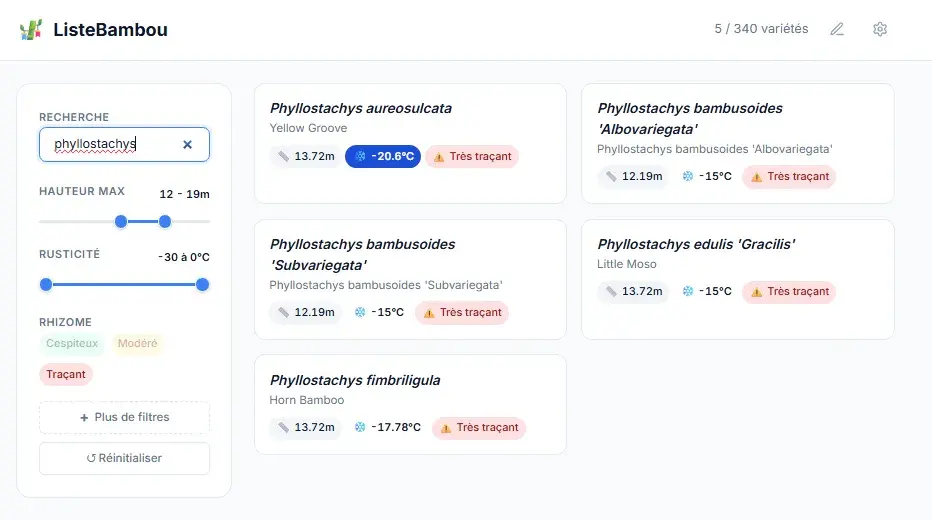
ListeBambou tool: https://nbzmhaso.gensparkspace.com/

Taking action

A dedicated area. A serious barrier. A solid connection. Annual inspection. That’s the difference between “complicated bamboo” and “mastered bamboo”.

Horticultural references: Guide de culture du bambou (RHS) and Contrôle du bambou (RHS).

Other articles