Where to plant a paulownia: location, distances, networks, neighbourhood
The choice of location determines the result. A well-placed paulownia is easy to manage. A poorly placed paulownia creates constraints: access, maintenance, competition, neighbor conflicts, easements. Here’s a field method, with precautionary distances and a decision grid.
Layout method: four-axis thinking
To decide where to plant a paulownia, a quick diagnosis is sufficient in most cases: soil, water, climate, access. If one axis is unfavorable, the location becomes costly to “make up”.
Damp, structured soil, without asphyxiation. Cold shallows and hydromorphic zones penalize recovery and growth.
Access to water secures recovery. Without irrigation, opt for areas with useful reserves and less drying exposure.
Prevailing wind, late frost, cold corridors. Machine access, turning, maintenance, watering, future cutting.
Precautionary distances: house, boundaries, networks, access
The distances below are designed to limit management constraints. They are designed to avoid overshadowing, forced pruning, and work on networks or easements.
| Case | Precautionary distance | Why | Risk if too close | Advice |
|---|---|---|---|---|
| House / building | ≥ 8-12 m | Branch management, shading, access | Conflict of use, sudden pruning | Keep away from living and traffic areas |
| Property line / fence | ≥ 4-6 m | Neighborhood, crown management, access | Litigation, trunk deformation | Keep a maintenance strip |
| Buried networks (water, gas, electricity, sewage) | ≥ 5-10 m | Protection of works, future interventions | Work, compulsory cutting | Locate networks, keep a neutral zone |
| Ditch / drain / wetland | ≥ 5-8 m | Asphyxiating soil, cold, uneven | Poor recovery, mortality | Avoid wet spots, correct drainage |
| Farm track / machinery access | ≥ 4-6 m | Maneuvers, impacts, handling | Injuries, breakage, cutting | Maintain right-of-way |
| Adjacent crop (agroforestry alignment) | Depending on itinerary | Shade, competition, cultivation work | Yield reduction, conflicts | Trace according to equipment and rotation |
Case studies: garden, border, plot, agroforestry
Garden and small right-of-way
- Objective: shade, light biomass, aesthetics.
- Location: away from traffic areas, far from utilities, avoid low-lying areas.
- Care: repeat watering, wind protection, regular maintenance.
Edge of agricultural plot
- Risk: compacted, damp areas, manoeuvring.
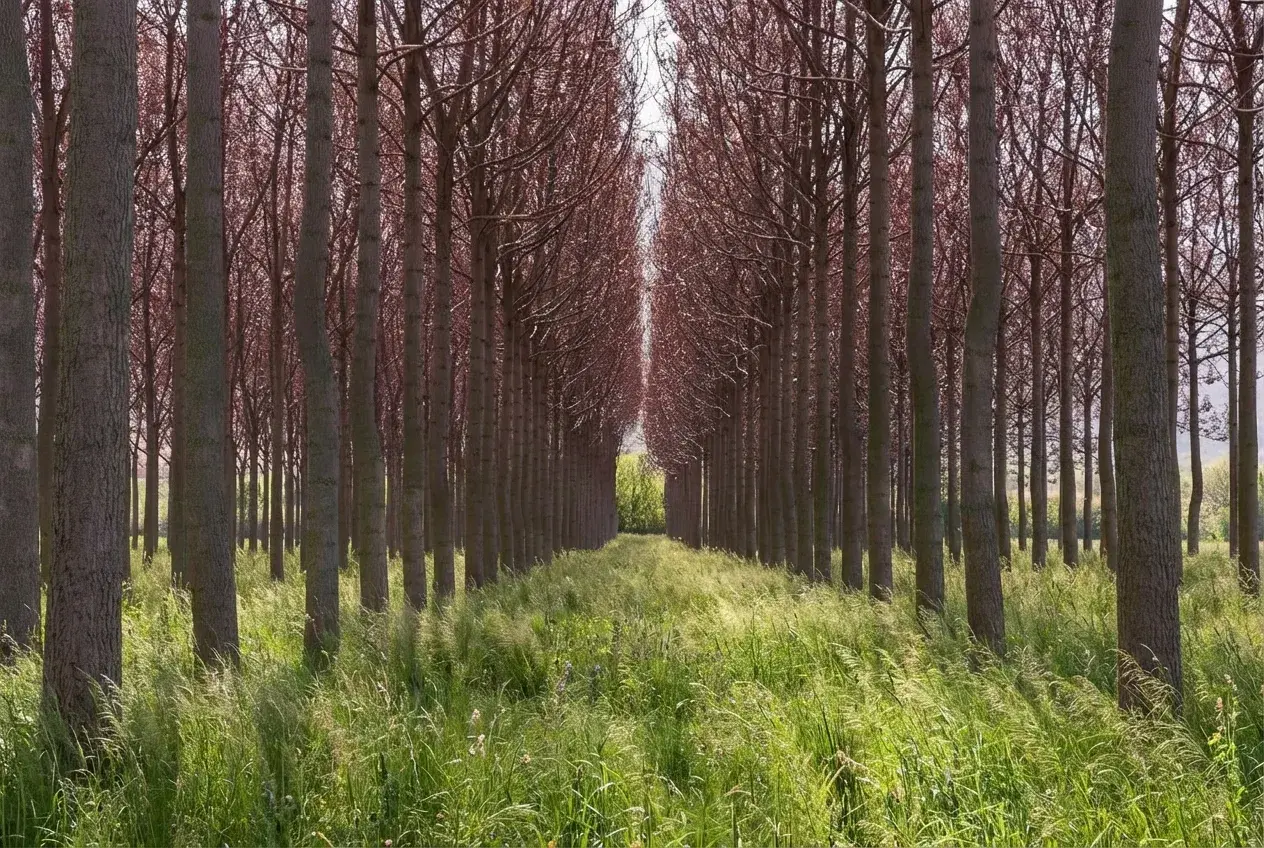
- Layout: straight line, access assured, maintenance strip retained.
- Careful weeding and pruning, otherwise trunk penalized.
Alignments in agroforestry
- Key point: mechanization dictates geometry.
- Layout: lines drawn on a chalk line, management of prevailing wind.
- Harvesting: anticipate harvesting and wood removal (access, load-bearing capacity, storage).
Layout grid: example of structured data
The grid below shows some common implementation cases, in the form of reusable data.
Display data in CSV format
case,distance_recommandee_m,distance_min_m,justification,risk,risk_level,remark maison_ou_batiment,8-12,6, "ombrage, entretien, gestion branches", "conflit d'usage / taille subie",eleve,"adapt according to future size" property_limit,4-6,3, "neighborhood, access maintenance", "dispute / deformed trunk",medium, "provide management strip" underground_networks,5-10,5, "future interventions", "work / imposed cut",high,"locate and maintain neutral zone" fosse_drain_zone_humide,5-8,4, "sol asphyxiant", "reprise faible / mortalité",eleve, "corriger drainage ou éviter" chemin_acces_engins,4-6,3, "manoeuvres, chocs", "blessures / arrachements",medium, "keep right-of-way" crop_neighbor_alignment,according_to_itinerary,according_to_itinerary, "shading, competition, harvesting", "lower yield / conflict",medium, "trace according to equipment and rotation".
Frequently asked questions
How far is a paulownia from a house?
A precautionary distance of 8 to 12 meters limits shading, emergency pruning and maintenance access.
Do paulownia roots impose special distances?
The most sensitive point concerns structures and networks. It is preferable to locate networks and avoid siting them on easement rights-of-way.
Can a paulownia be planted on the edge of an agricultural plot?
Yes, if the border is drained and accessible, and if the line is laid out in a way that is consistent with mechanization. Wet or compacted areas give poor planting.
Professional project: supply and support
Tapering rates, varietal selection support, planting recommendations and cultivation advice according to your context.