Practical guide – Fast growing hedges – Biomass – Rhizome control
Tracking or non-tracking bamboo: which to choose for rapid growth?

If your goal is a quick-breaking screen or biomass potential, the tracer is often the right choice. It is more vigorous. Above all, it needs to be controlled from the moment it is planted.
In practice: if you’re looking for a lot of rods and a quick height, you’re often on Phyllostachys. If you’re looking for peace and quiet, Fargesia is often more suitable.
1) The real difference: rhizome behavior
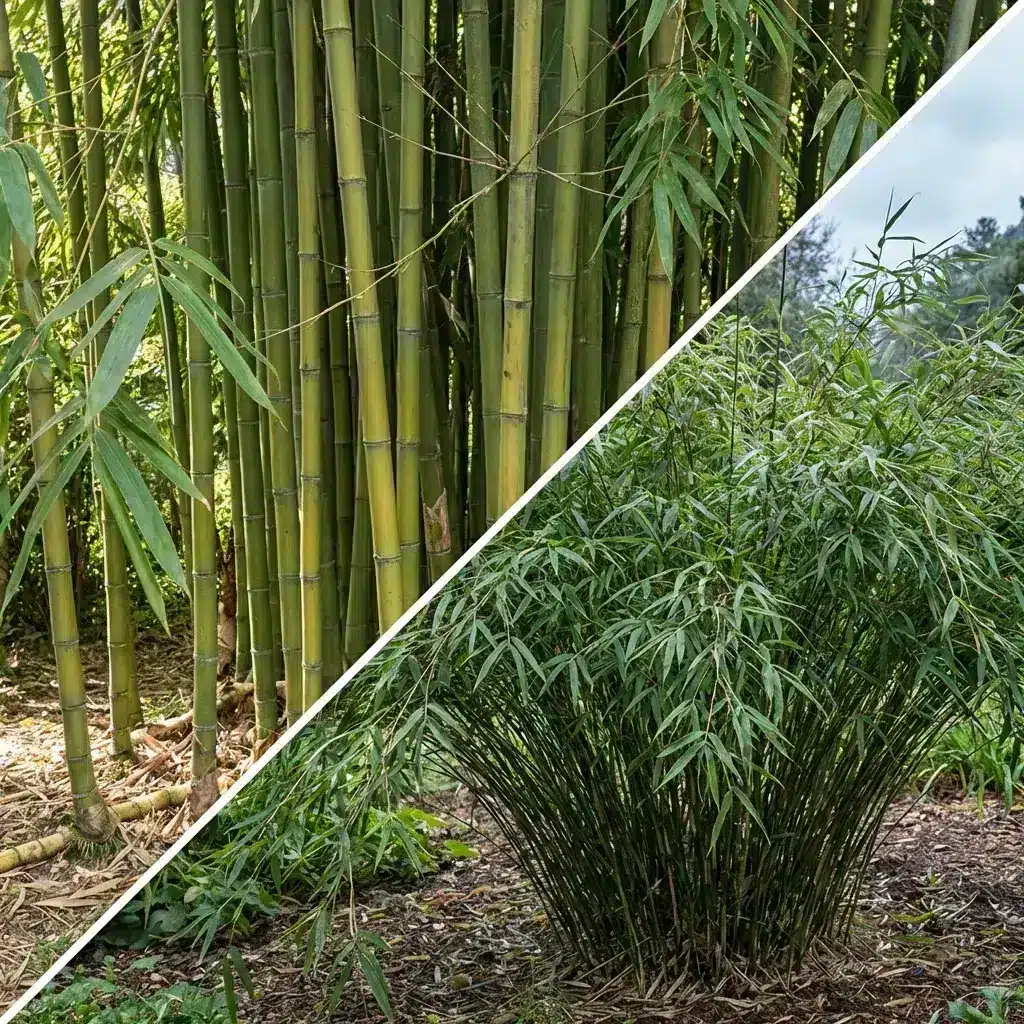
Trailing bamboo (Phyllostachys)
It spreads by means of rhizomes (underground stems) that can spread away from the foot. Canes may appear at a distance.
- Result Dense hedge more quickly, large volume possible.
- Points of attention Control near boundaries, terraces and ponds.
- Approach Containment from planting, followed by regular monitoring.
Non-tracking bamboo (Fargesia)
It stays in clumps. It grows more slowly, more compactly, around the foot.
- Result Very reassuring, limited extension.
- Strengths Simple management in small gardens.
- Limit “Express” break less frequent for the same variety.
2) Why the tracer is sought (hedge / biomass)
The tracer is chosen because it can occupy space quickly. This serves two very frequent purposes:
- Screening hedge: achieve screening more quickly, especially with vigorous varieties.
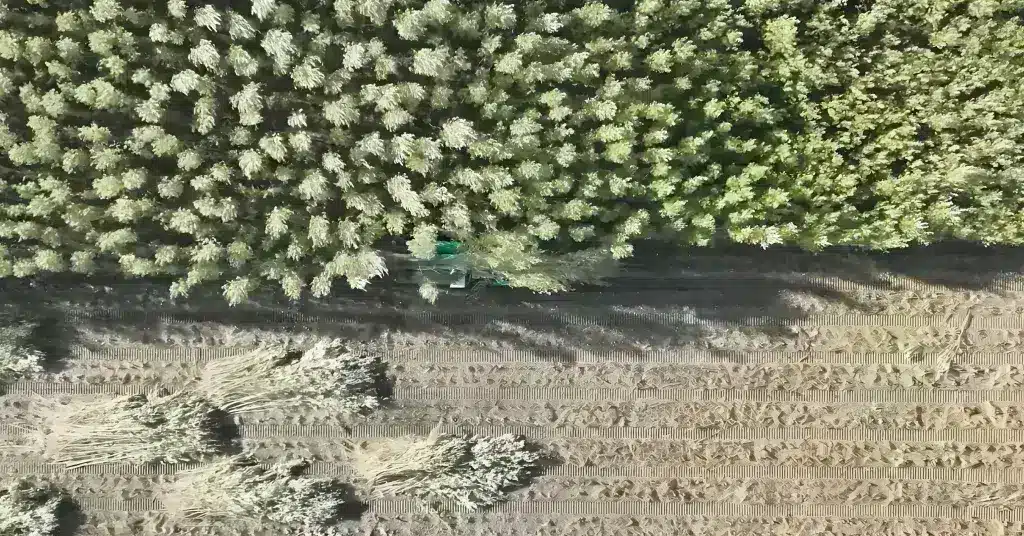
- Biomass: produce more plant matter, if management follows (water, fertility, density).
Potential depends on soil, water and exposure. Moist, rich soil = stronger vigor. Dry, poor soil = often more restrained behavior.
3) “Invasive”: risk exists, but so does control
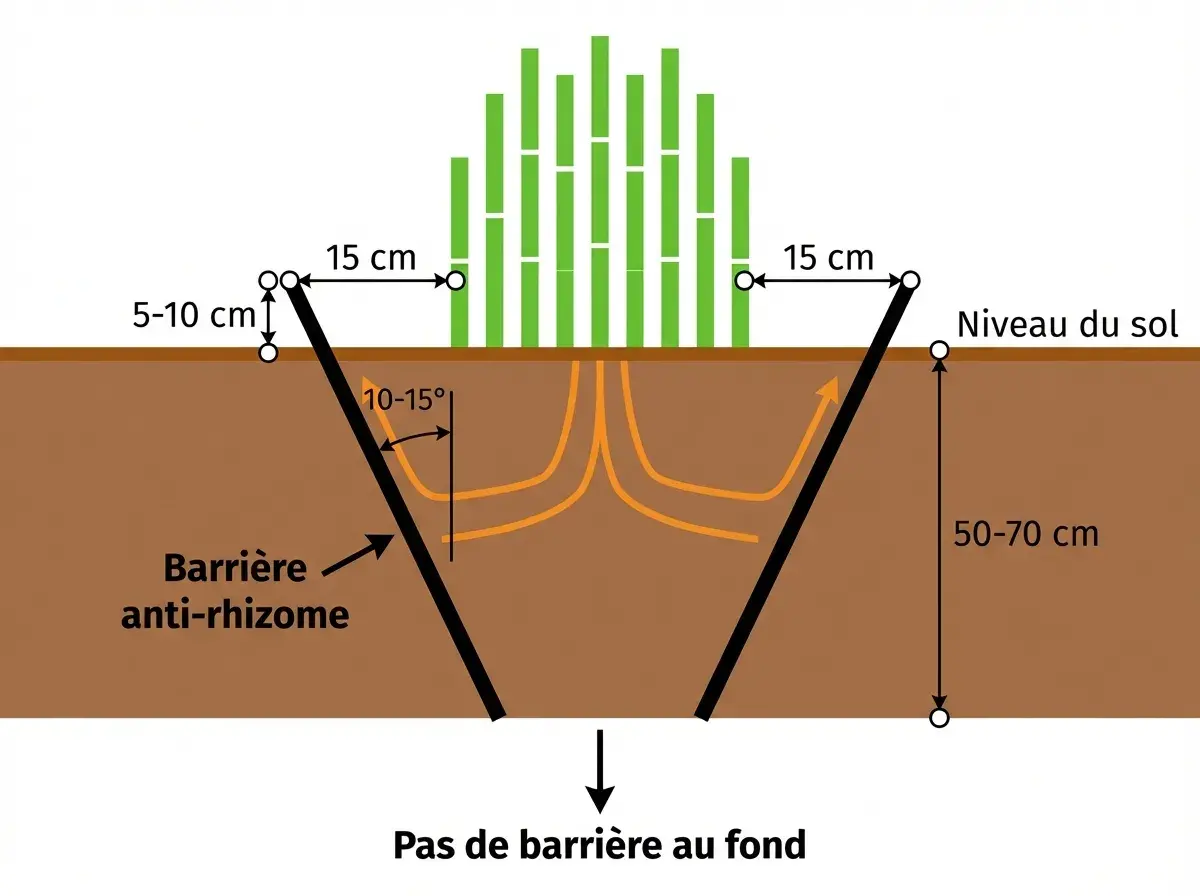
The main risk comes from one point: allowing rhizomes to leave the designated area. Control is based on two simple levers: containment and control.
This increases the risk
- Moist soil + rich + sheltered area.
- Lack of containment or leaks.
- Planting too close to a neighbor or structure.
This greatly reduces the risk
- Containment at planting.
- Sufficient dedicated area (avoid areas that are too narrow).
- Annual control of rhizomes on the periphery.
4) Quick comparison
| Criteria | Tracing (Phyllostachys) | Non-tracking (Fargesia) |
|---|---|---|
| Blackout speed | Often faster | More gradual |
| Biomass potential | High | More limited |
| Propagation | To be controlled | Low |
| Management | Containment + control | Standard maintenance |
| Typical cases | Fast-growing hedges, large plots | Constrained gardens |
5) If you’re starting out with tracers: simple checks
- Define a dedicated area. Avoid property lines if not confined.
- Containment at planting. Continuous barrier with no weak points.
- Save room. An area that’s too narrow encourages exits.
- Annual inspection. Peripheral inspection and cutting of exploratory rhizomes.
- Pilot the water. More water = more vigor. Advantage if controlled.
Frequently asked questions
Will a tracer bamboo necessarily spread everywhere?
No. Without containment, it can leave the designated area. With containment and regular monitoring, you keep the perimeter under control.
Where can I find other articles (hedges, fences, varieties, biomass)?
You’ll find it all here: https://agribiomix.com/bambou/
How do I choose the right variety for my needs?
Use the bamboo search tool: https://nbzmhaso.gensparkspace.com/
Taking action
Three options, depending on your objective:
- Go fast (hedge/volume): choose a bamboo with good tracking.
- Choose the best variety: use ListeBambou.
- Understand it all: read the guides in the Bamboo folder.